

In the shadows of Python Cave, Uganda, a leopard leaps from a guano mound – formed by bat excrement – and sinks its teeth into a bat. But this is no ordinary bat colony. The thousands of Egyptian fruit bats (Rousettus aegyptiacus) found in this cave are known carriers of one of the world’s deadliest viruses: Marburg, a close cousin of Ebola.
Over just four months, our cameras recorded 261 predator encounters: crowned eagles, Nile monitors, leopards, pythons and blue monkeys all caught feeding on, or scavenging from this virus-harbouring colony.
And yet, this wasn’t the work of a global health agency or virology lab. The discovery came from a 25-year-old Ugandan undergraduate, Bosco Atukwatse, working with our small Volcanoes Safaris Partnership Trust Kyambura Lion Projectteam in Queen Elizabeth National Park. His only tools: a trail camera, curiosity and ecological instinct.
I am a conservation scientist with over 17 years of experience in wildlife ecology, monitoring and human-wildlife conflict. I’m the co-founder of the Kyambura Lion Project, which made this discovery.
For years, scientists studying how diseases spread from animals to humans have hypothesised that zoonotic diseases jump from a wildlife reservoir (like a bat) to an intermediate host (monkey) and potentially to us, humans.
For past Marburg outbreaks in Uganda, two spillover pathways have been identified: the first, involves humans coming into contact with a fruit bat habitat (namely caves filled with bat guano). Indeed, fruit bats are thought to have infected two tourists at Python Cave in 2007 and 2008.
The second pathway involves humans and animals eating the same fruit that bats have fed upon or made contact with. This second spillover pathway was identified by Centers for Disease Control and Prevention scientists in 2023. They tracked bats from the cave entering cultivated gardens to feed.
But Atukwatse and the team of young Ugandan scientists (Yahaya Ssemakula, Johnson Muhereza, Orin Cornille and Winfred Nsabimana) have potentially found another pathway: predation by at least 14 species.
Such rich visual evidence of a viral interface – bats, predators and people – is virtually non-existent in the literature. Many theoretical depictions of this process exist, and there are isolated incidents of a monkey predating on a bat or wildlife feeding on bat guano, but Atukwatse’s discovery of this many different predators repeatedly feeding on a known Marburg virus reservoir is a first.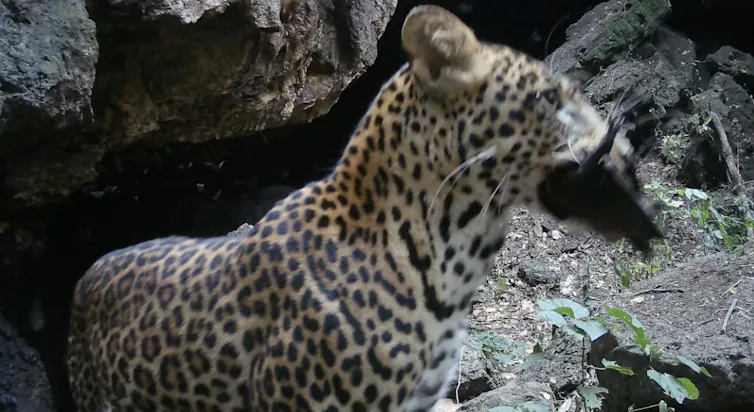
His discovery highlights two uncomfortable truths:
- many potential zoonotic interfaces remain undocumented – often right under our noses
- the people most likely to detect them first are those living closest to wild frontiers.
But the bigger message is this: global health institutions need to stop overlooking local scientists and start funding field-based detection systems across Africa and Asia.
If we want to detect the next outbreak early, we should be empowering more Atukwatses, not waiting for the next lab test.
In early February 2025, Atukwatse and our small team of local scientists was expanding our long-term African leopard and spotted hyena monitoring grid into a new part of Queen Elizabeth National Park – the Kyambura Wildlife Reserve and Maramagambo forest.
Atukwatse had heard from nearby guides that a large bat cave lay close to the survey grid. That kind of site, he reasoned, could be perfect leopard territory: a place to hunt, rest or avoid the heat.
This is ecological attentiveness at its best – the field biology equivalent of a commodities trader spotting volatility in a geopolitical flashpoint.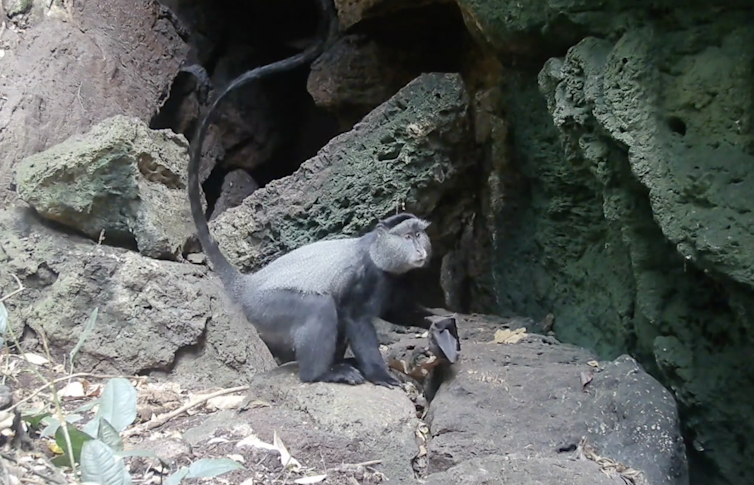
Atukwatse had his radar on and acted on instinct, setting five camera traps at the cave’s entrance and along the surrounding animal trails. Just one week later, he got what he hoped for: three separate clips of a leopard hunting bats in broad daylight. He left the cameras in place in protective casing. He checked them every 7–10 days.
When I first looked at Atukwatse’s videos, our joint excitement was around the leopard footage. We knew they were adaptable and could even eat small rodents , but no one had ever recorded them eating bats in Africa.
As more clips came in, we realised something bigger was unfolding. Blue monkeys were seen grabbing bats mid-roost. A crowned eagle and a Nile monitor fought over two bat carcasses. A fish eagle – typically a piscivore, which is a carnivorous species that primarily eats fish – was filmed clutching bats in its talons.
