

The question of whether men or women are more polygamous or polyandrous has haunted human societies across centuries, whispered in folklore, immortalized in religion, debated in academic halls, and lived out in the secret corners of human relationships. At the heart of this conversation lies not just biology, but culture, economics, spirituality, and power. To speak of it is to open a dialogue that stretches from the ancient courts of African kings to the modern dating apps of New York and Lagos. It is both an anthropological exploration and a mirror of human desire.
When we ask who is more polygamous, the male or the female, we must first recognize that polygamy and polyandry are not merely sexual or romantic instincts. They are social institutions, deeply embedded in culture. Polygamy—one man with multiple wives—has been historically normalized across vast civilizations: the Oyo Alaafin in Yoruba land with scores of wives; the Biblical patriarch Solomon with his seven hundred wives and three hundred concubines; Islamic caliphs and sultans who claimed harems as signs of power; and even the Zulu monarchs whose legitimacy often rested on the number of their households. Polyandry, though less celebrated, has quietly existed too. In the frigid Himalayan villages of Tibet, one woman traditionally marries several brothers to preserve family land. Among the Nair of Kerala in India, polyandrous arrangements were once part of matrilineal traditions. Even in Nigeria, oral histories recall instances where powerful women, priestesses, or traders had multiple male partners within socially sanctioned frameworks.
Biology gives us a starting point. Men produce millions of sperm daily, while women produce one ovum monthly. Evolutionary psychologists argue that this asymmetry drives men toward spreading their seed widely, while women, limited in reproductive capacity, choose mates carefully. This, however, is a reductionist view. It overlooks that women, too, may secure multiple partners—not always for reproduction, but for economic stability, protection, and emotional fulfillment. In war-torn societies or famine-stricken communities, a woman’s survival and that of her children sometimes depended on cultivating more than one male alliance. Polyandry thus became not only practical but protective.
 Religion has shaped the visibility of these practices. Islam permits a man up to four wives under strict conditions of fairness, while Christianity insists on monogamy yet narrates Old Testament stories soaked in polygamous realities. Hinduism, in its epics, records both polyandry—the Pandava brothers sharing Draupadi—and polygamy, with kings marrying princesses to expand kingdoms. African traditional religions, free from Abrahamic restrictions, normalized polygamy as a sign of wealth, status, and spiritual balance. Yet almost nowhere, except in rare societies, was polyandry institutionalized in the same breadth.
This imbalance does not mean women are less inclined to multiple partnerships. Modern data reveals a more nuanced truth. Global surveys on infidelity show that women are increasingly closing the gap with men. A 2019 Institute for Family Studies report in the United States found that while older generations of women were far less likely to cheat, younger women between ages 18 and 29 reported infidelity at rates equal to or surpassing men. In sub-Saharan Africa, studies on urban relationships show that women in economic hubs like Lagos, Accra, and Johannesburg engage in “polyandrous realities,” though not formally named as such—maintaining relationships with multiple men for financial, emotional, and social security. The terminology has changed, but the essence mirrors traditional polyandry.
Cultural expectations also determine who gets labeled polygamous or polyandrous. A man with many wives in Igbo land was celebrated as an Ogaranya, a wealthy man whose household reflected his status. A woman with multiple husbands, however, would be stigmatized. Patriarchy has, for centuries, given men the privilege to formalize their plurality while women’s multiplicity was silenced or branded immoral. Yet, when stripped of cultural judgment, women’s polyandrous tendencies appear in folk songs, in hidden narratives, and in the whispered realities of market women who sustain parallel alliances across towns.
 Technology has further complicated the debate. Dating apps like Tinder, Bumble, and Badoo have globalized access to multiple partners. In this digital age, women wield unprecedented agency in selecting, testing, and sustaining multiple romantic engagements. Men, once assumed the default polygamists, now face a competitive reality where women’s polyandry is not only viable but flourishing, often discreetly. The world of “sugar relationships,” where younger men align with older women for support, is another mirror of this reversal.
Historically, migration and diaspora also shaped these dynamics. In African diaspora communities in the Caribbean and South America, enslaved men often lacked power to form households. Women, left to fend for themselves, adapted to polyandrous arrangements to ensure the survival of their children. Here, polyandry was less about choice and more about resilience. Conversely, wealthy plantation owners institutionalized polygamy, fathering children with multiple enslaved women. The story of polygamy and polyandry, therefore, is not just about desire, but about who holds power.
Even science suggests that human beings are not strictly monogamous by nature. Anthropologists like Helen Fisher argue that humans are “serially monogamous” but wired for opportunistic plurality. Genetic studies reveal high rates of “extra-pair paternity”—children conceived outside a woman’s primary union—proving that women, too, have quietly navigated polyandry across generations, regardless of societal disapproval.
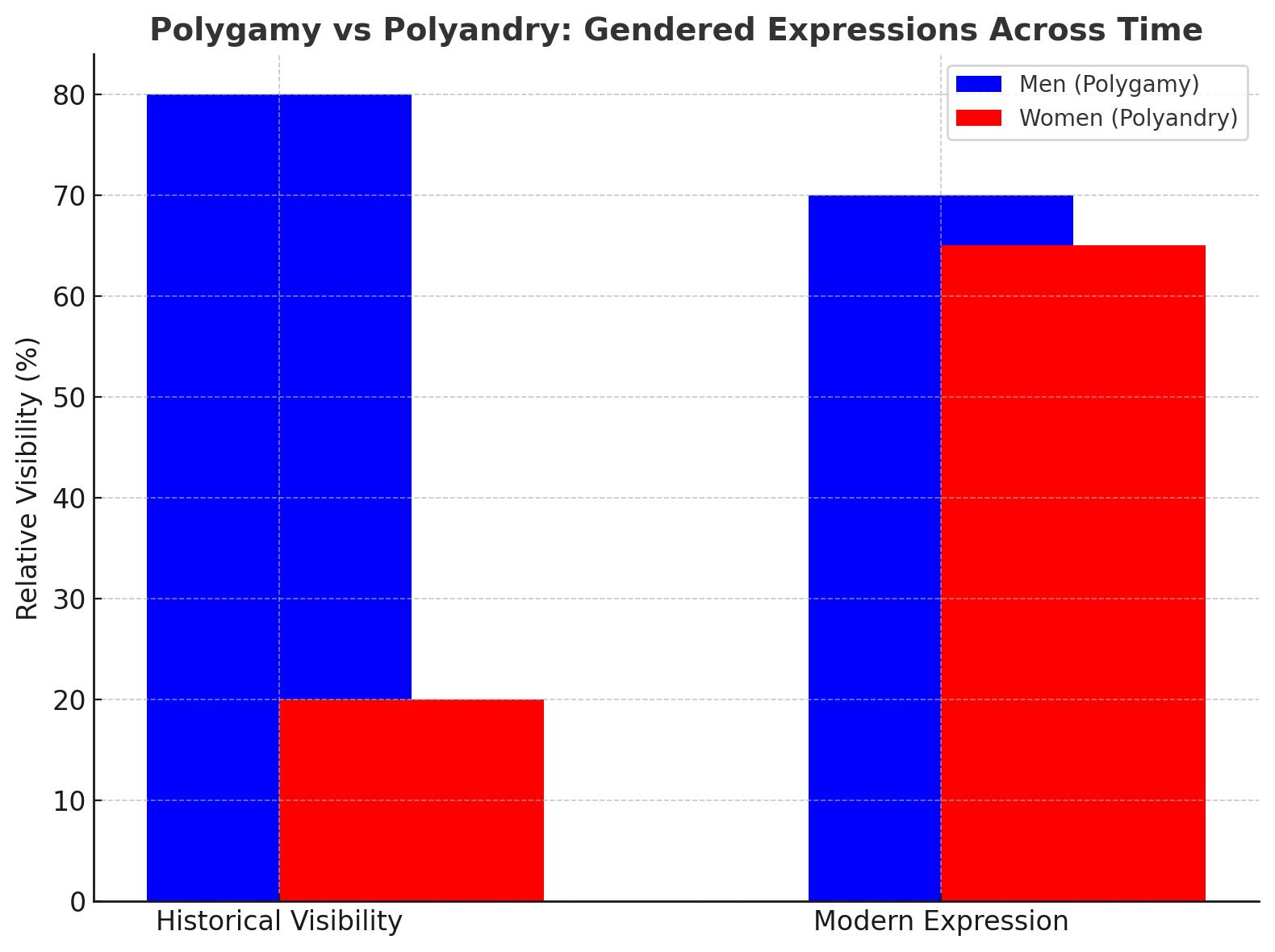
So, who is more polygamous or polyandrous? The answer resists simplicity. Men have historically had the institutional and religious backing to practice polygamy openly, making their plurality more visible. Women, constrained by cultural restrictions, have often practiced polyandry discreetly, though no less significantly. In societies where women are empowered—economically, legally, and socially—the evidence suggests their polyandrous tendencies surface with clarity, challenging long-held assumptions.
The conversation, then, is less about who desires multiple partners more, and more about who society allows to practice it. Polygamy has been glorified, inscribed into the histories of kings and prophets, while polyandry has been hidden, whispered, or condemned. Yet, beneath the surface of cultures and religions, both men and women are capable of plurality. The difference lies in how power, economics, and morality shape the narrative.
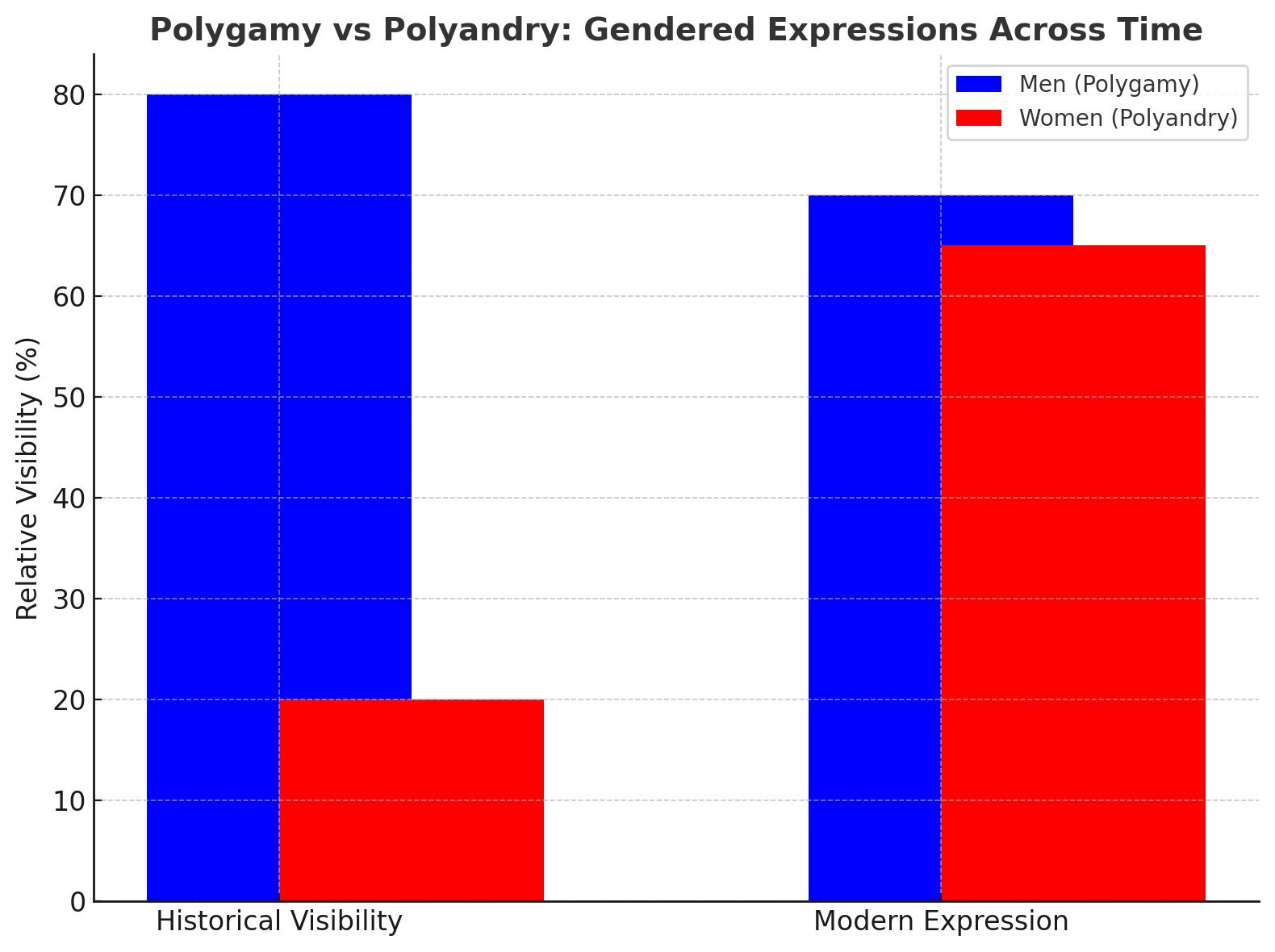
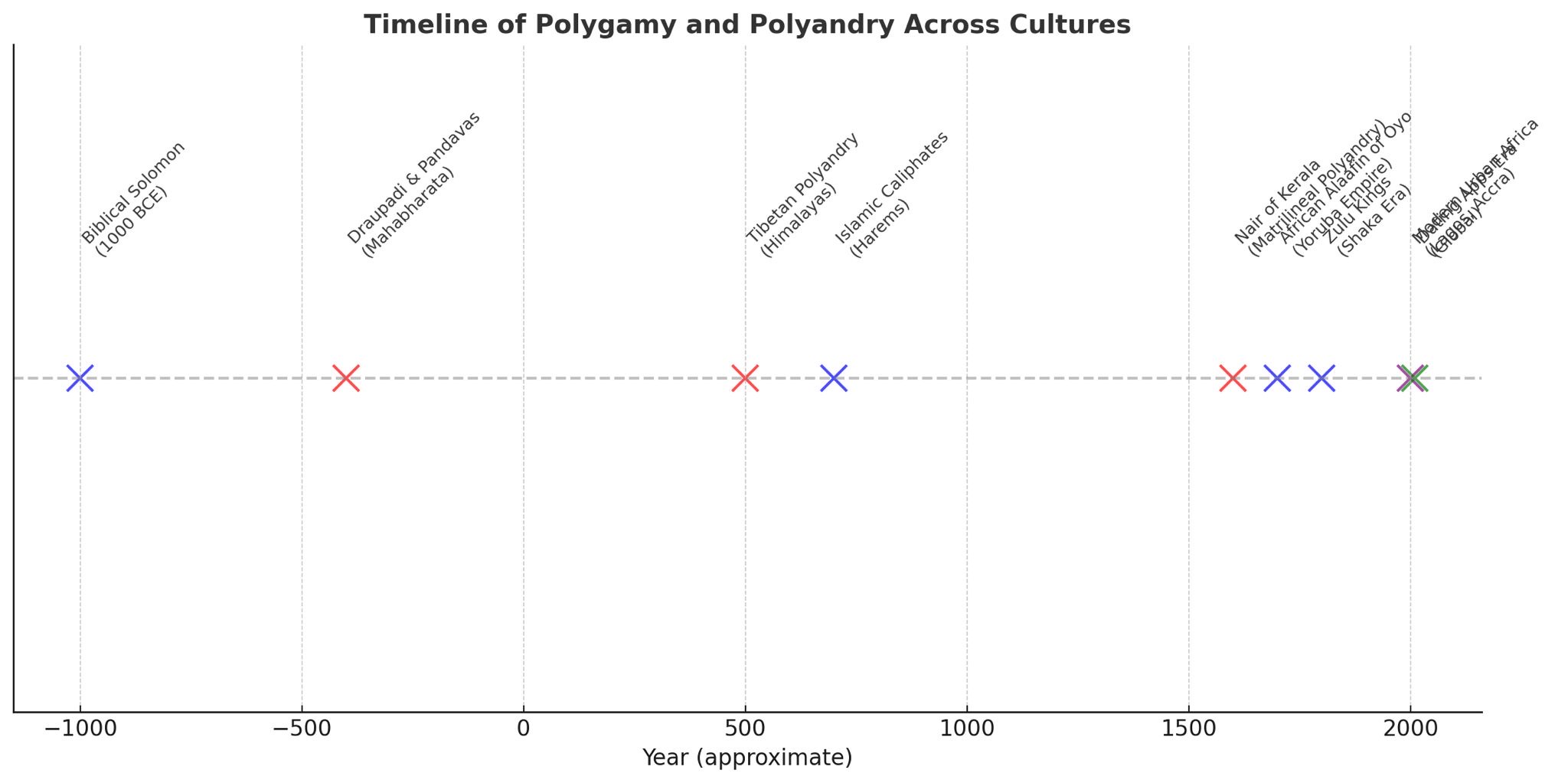
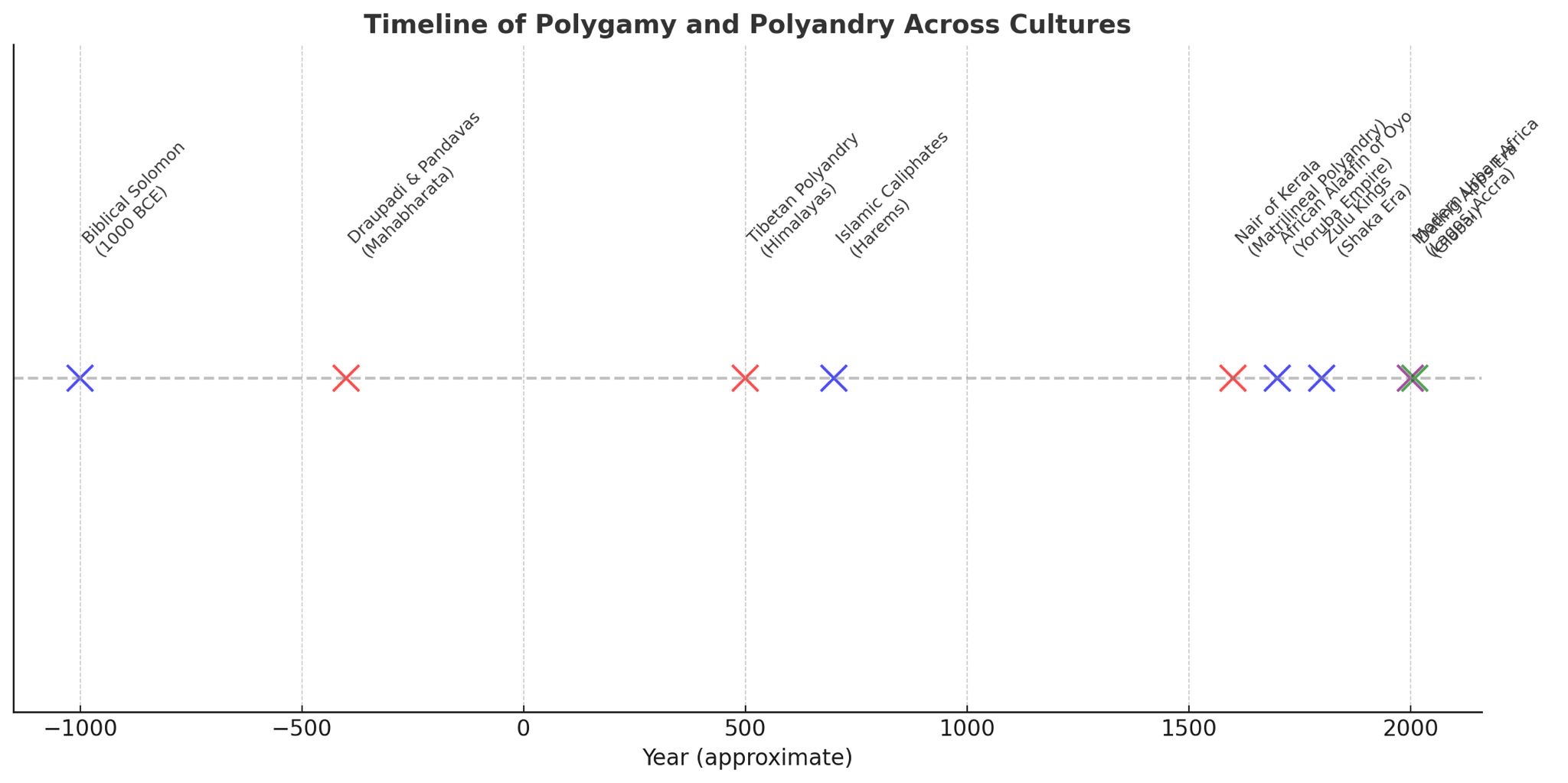 To answer the debate with honesty, we must conclude that men appear more polygamous because history has institutionalized their plurality. Women appear less polyandrous only because their plurality has been silenced. Strip away the structures, and the human instinct reveals symmetry: both genders are capable of multiple loves, multiple alliances, and multiple commitments. The difference lies not in nature, but in nurture; not in biology, but in the weight of tradition.
The debate will continue, as it should, because it is a mirror of our evolving humanity. But to reduce it to numbers alone would be to miss the essence. Polygamy and polyandry are not just practices—they are reflections of desire, power, survival, and culture. And in that reflection, men and women are not so different after all.
