

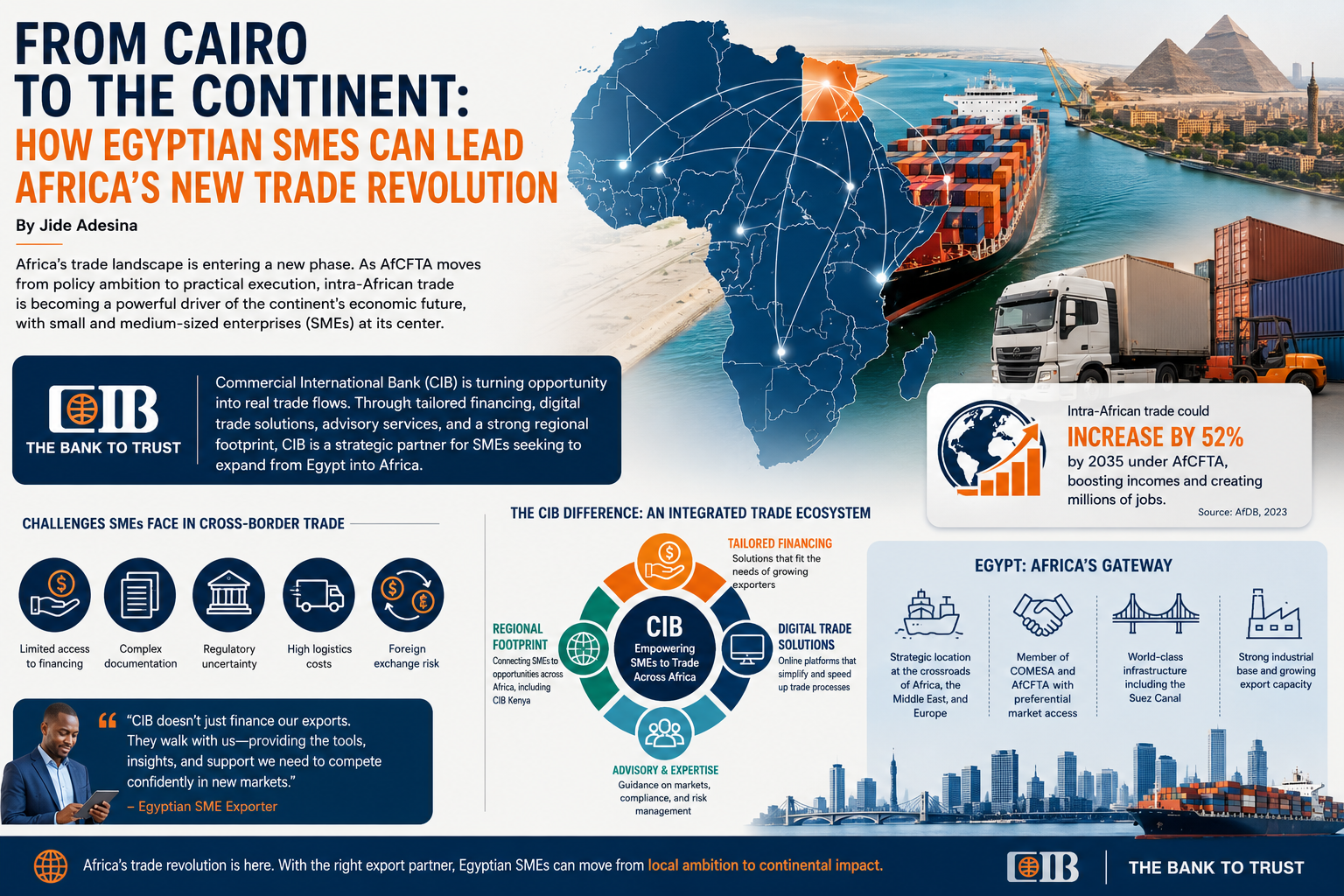
Africa stands at a defining economic moment. For decades, the continent’s economies have been heavily dependent on exporting raw materials to markets outside Africa while importing manufactured goods and services at significant cost. The result has been a fragmented trade environment where neighboring countries often traded more with distant partners than with each other. Today, however, that reality is beginning to change.
The implementation of the African Continental Free Trade Area (AfCFTA), combined with ongoing regional integration efforts, is reshaping Africa’s commercial landscape. What was once viewed as a long-term political aspiration is steadily becoming an economic reality. As tariffs fall, trade corridors improve, and governments align regulations, intra-African trade is emerging as one of the most significant drivers of the continent’s future growth.
At the heart of this transformation are small and medium-sized enterprises (SMEs). These businesses account for the overwhelming majority of enterprises across Africa and contribute substantially to employment, innovation, and economic development. Yet despite their importance, SMEs continue to face structural barriers that limit their ability to expand beyond domestic markets.
The next chapter of African economic growth will largely depend on whether these businesses can successfully integrate into regional and continental value chains. For many of them, the challenge is not a lack of ambition but a lack of access to the financial tools, trade infrastructure, market intelligence, and institutional support required to compete across borders.
Against this backdrop, Egypt is emerging as one of the continent’s most strategically positioned gateways for trade expansion, while Commercial International Bank (CIB) is seeking to play a pivotal role in helping Egyptian SMEs translate opportunity into measurable growth.
Africa’s Untapped Intra-Continental Trade Potential
According to numerous studies by African development institutions and international trade organizations, intra-African trade remains significantly lower than intra-regional trade levels seen in Europe, Asia, and North America. While European countries conduct a majority of their trade within the continent, African economies continue to trade disproportionately with external partners.
This imbalance represents both a challenge and an opportunity.
The AfCFTA seeks to create the world’s largest free trade area by number of participating countries, connecting more than 1.4 billion people and creating a combined market worth trillions of dollars. If fully implemented, the agreement has the potential to significantly increase trade among African nations, stimulate industrialization, strengthen regional value chains, and create millions of jobs.
Yet the promise of AfCFTA cannot be realized through policy declarations alone.
Businesses must be equipped to navigate customs requirements, manage payment risks, secure trade financing, access foreign markets, and compete effectively within increasingly integrated economies. This is particularly true for SMEs, which often lack the resources and expertise available to larger multinational corporations.
For many entrepreneurs, crossing a border with goods can still involve navigating complicated documentation procedures, fluctuating currency markets, inconsistent regulations, and high logistics costs. These realities create friction that can discourage expansion despite strong market demand.
Consequently, the institutions that succeed in supporting Africa’s next generation of exporters will be those that move beyond traditional banking services and provide comprehensive ecosystems that enable trade.
Egypt’s Strategic Position in a Changing Trade Environment
Few African countries are as strategically positioned to capitalize on this transformation as Egypt.
Located at the intersection of Africa, the Middle East, and Europe, Egypt occupies one of the most important trade corridors in the world. The Suez Canal remains a cornerstone of global maritime commerce, facilitating the movement of goods between major international markets and generating significant economic value for the country.
Beyond geography, Egypt’s participation in regional economic frameworks provides additional advantages. Through its involvement in the Common Market for Eastern and Southern Africa (COMESA) and the African Continental Free Trade Area, Egyptian businesses gain access to an expanding network of preferential trade arrangements across the continent.
This unique combination of geographic positioning, infrastructure, industrial capacity, and market access gives Egyptian SMEs a significant competitive advantage.
Industries such as agribusiness, food processing, textiles, pharmaceuticals, light manufacturing, construction materials, technology services, and consumer goods stand to benefit considerably from increased regional integration. As African consumer markets continue to expand and urbanization accelerates, demand for these products and services is expected to rise substantially.
However, geographical advantages alone do not automatically translate into commercial success. Businesses require practical support to convert opportunities into export revenues.
This is where financial institutions increasingly become catalysts for economic transformation.
Redefining the Role of Banking in African Trade
Historically, banks were primarily viewed as providers of credit and transactional services. In today’s interconnected trade environment, however, their role is evolving rapidly.
Modern trade finance increasingly requires institutions to function as advisors, facilitators, technology partners, and ecosystem builders.
Commercial International Bank’s approach reflects this shift.
Recognizing that SMEs require more than access to capital, the bank has developed solutions designed to address the broader challenges associated with cross-border commerce. Rather than treating trade finance as a standalone financial product, CIB is integrating financing, advisory services, digital infrastructure, and market connectivity into a unified support framework.
This evolution mirrors broader global trends where leading financial institutions are investing heavily in technologies and services that simplify international trade for smaller businesses.
The objective is straightforward: reduce barriers, improve efficiency, and enable companies to scale beyond domestic markets.
For SMEs, this integrated support model can be transformative. Access to financing remains essential, but equally important is the ability to understand regulatory environments, manage trade documentation, mitigate risks, optimize working capital, and identify trustworthy commercial partners.
The businesses that master these capabilities will be best positioned to benefit from Africa’s expanding economic integration.
The CIB Export Bundle and the Rise of Tailored Trade Solutions
One notable example of this strategy is the CIB Export Bundle, developed specifically for exporters within the Commercial and Business Banking segments.
The initiative represents a recognition that exporters face challenges that differ significantly from those of businesses operating exclusively within domestic markets.
Exporters must manage international documentation requirements, payment collection processes, shipping logistics, compliance obligations, and foreign market risks. A generic banking solution often falls short of addressing these complexities.
The Export Bundle seeks to bridge this gap by combining financial support with strategic services designed to assist businesses throughout the export journey.
This reflects a growing understanding among financial institutions that successful trade finance must be embedded within a broader ecosystem of support. Businesses require not only funding but also guidance, expertise, and operational capabilities that help them compete internationally.
As African markets become increasingly interconnected, such specialized solutions are likely to become more important rather than less.
Digital Transformation and the Future of Trade Facilitation
One of the most significant developments reshaping trade across Africa is digitization.
For many years, cross-border transactions were slowed by manual paperwork, physical branch visits, lengthy approval processes, and fragmented communication systems. These inefficiencies imposed costs that disproportionately affected smaller businesses.
Digital platforms are changing that equation.
By enabling businesses to submit, manage, track, and process trade-related documentation electronically, digital trade solutions can dramatically reduce transaction times and improve operational efficiency.
CIB’s digital process for export document collection services illustrates this trend. By allowing exporters to manage documentation through online channels, the bank helps eliminate unnecessary administrative burdens while improving convenience and accessibility.
The impact extends beyond efficiency.
Digital systems can enhance transparency, reduce errors, improve compliance monitoring, and strengthen confidence among trading partners. In a competitive marketplace where speed and reliability often determine commercial success, these advantages can prove decisive.
Yet technology alone is not enough.
Many SMEs remain at different stages of digital maturity and may require guidance when adopting new platforms. Recognizing this reality, CIB has complemented its technological investments with dedicated support teams that assist clients in navigating digital systems and addressing trade-related challenges.
This combination of digital innovation and human expertise reflects an important lesson in Africa’s digital transformation journey: technology delivers its greatest value when paired with accessible support and practical implementation.
Kenya and the Expanding African Opportunity
A particularly important component of CIB’s regional strategy is its presence in Kenya.
Kenya serves as one of East Africa’s leading commercial hubs and plays a central role in regional trade networks. Its strategic location, relatively diversified economy, and growing role in technology and financial services make it an attractive gateway into broader East African markets.
For Egyptian businesses seeking expansion opportunities, Kenya offers direct access to important trade corridors and commercial relationships throughout the region.
Through its Kenyan operations, CIB can help facilitate transactions, provide local market insights, strengthen business relationships, and support companies entering unfamiliar territories.
This regional footprint aligns with a broader trend among African financial institutions seeking to establish networks that facilitate intra-continental commerce rather than merely serving domestic markets.
As AfCFTA implementation advances, such networks will likely become increasingly valuable.
Managing Currency Risk in an Uncertain World
Foreign exchange volatility remains one of the most significant challenges facing African businesses engaged in cross-border trade.
Fluctuating currency values can erode profit margins, complicate pricing strategies, and create uncertainty for exporters and importers alike.
The ability to facilitate transactions in local currencies therefore represents a meaningful advantage.
Reducing dependence on the US dollar can help businesses lower transaction costs, improve predictability, and strengthen financial planning. It can also contribute to broader regional financial integration by encouraging greater use of African currencies in intra-continental trade.
As policymakers and financial institutions continue exploring mechanisms that support local currency settlement, businesses may gain additional tools for managing risk and improving competitiveness.
Building Stronger Regional Value Chains
The ultimate success of AfCFTA will depend not simply on increased trade volumes but on the development of resilient regional value chains.
Africa has long exported raw materials while importing finished products. Regional integration creates an opportunity to change that dynamic by encouraging more value addition, manufacturing, processing, and industrial collaboration within the continent.
SMEs will play a central role in this transition.
Whether producing agricultural products, manufacturing consumer goods, providing logistics services, or delivering technology solutions, small and medium-sized enterprises have the potential to become critical participants in interconnected African supply chains.
However, participation requires access to financing, trusted buyers, reliable suppliers, efficient payment systems, and market information.
By connecting exporters with African buyers and collaborating with trade facilitation entities, institutions such as CIB are helping create the relationships and infrastructure necessary to support these emerging value chains.
The long-term economic benefits could be substantial. Stronger regional supply networks can increase resilience, reduce dependency on external markets, create employment opportunities, and support industrial development across multiple sectors.
Sustainability and the Next Generation of Trade Finance
Another important dimension of modern trade finance is sustainability.
Environmental, social, and governance (ESG) considerations are increasingly influencing investment decisions, supply chain management, and access to capital.
Businesses operating within international markets are facing growing expectations regarding environmental responsibility, resource efficiency, and sustainable business practices.
Financial institutions are responding by incorporating sustainability principles into their products and services.
CIB’s integration of ESG considerations into its trade strategy reflects a broader recognition that economic growth and sustainability are no longer separate objectives. Digital trade platforms, sustainable financing initiatives, and support for environmentally responsible supply chains indicate a future where commercial success and sustainable development become increasingly interconnected.
For African businesses, embracing sustainability may not only enhance competitiveness but also improve access to investment and international market opportunities.
A Defining Decade for African Commerce
Africa’s economic future will not be determined solely by governments, trade agreements, or international investors. It will be shaped by millions of entrepreneurs, manufacturers, exporters, and innovators who seize the opportunities created by regional integration.
The continent is entering a period where trade corridors are expanding, digital technologies are reducing barriers, and regional markets are becoming increasingly interconnected.
For Egyptian SMEs, the opportunity is particularly compelling.
Egypt’s strategic location, industrial capabilities, and regional partnerships provide a strong foundation for growth. Yet capitalizing on these advantages will require more than ambition. It will demand access to finance, reliable trade infrastructure, digital capabilities, regional expertise, and trusted institutional partners.
Commercial International Bank is positioning itself to play a significant role in this transformation. By combining trade finance, digital innovation, advisory support, regional connectivity, and sustainability-focused solutions, the bank is helping create the conditions under which Egyptian businesses can move confidently beyond national borders.
The success of these efforts will not only benefit individual enterprises. It could contribute to a broader vision of a more integrated, prosperous, and self-sustaining Africa—one where trade flows increasingly between African nations, value is created within the continent, and SMEs become the engine powering a new era of economic growth.
The road ahead remains complex, but the direction is increasingly clear. Africa’s trade revolution is no longer a distant aspiration. It is underway, and those businesses prepared to embrace it may help define the continent’s economic story for decades to come.
Jide Adesina is the Founder and Editor-in-Chief of 1st Afrika and Global Afrika Network. He writes on African development, international trade, geopolitics, economic transformation, and emerging opportunities shaping the continent’s future.
