

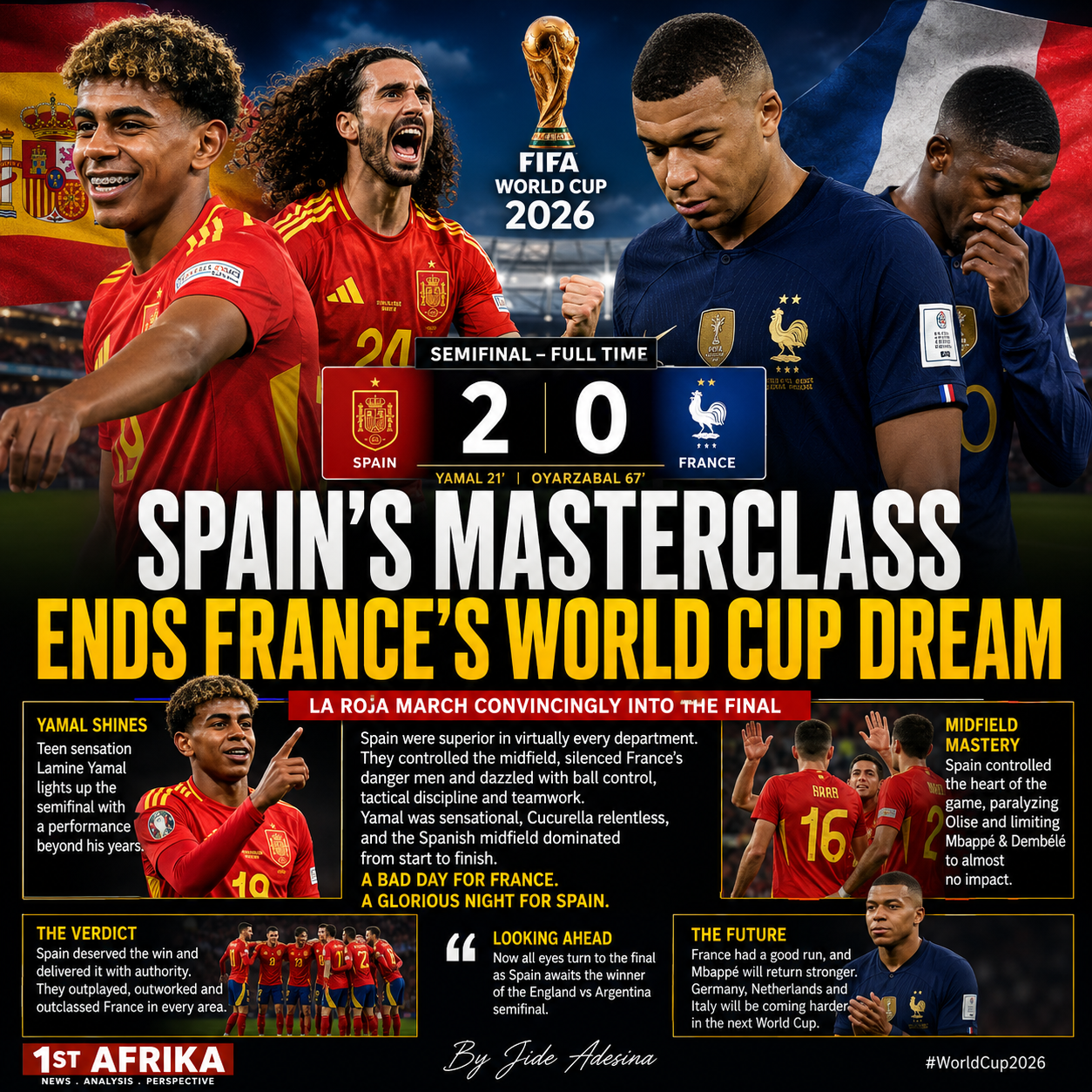
The FIFA World Cup has always reserved its grandest theatre for encounters like this. When Spain and France walked onto the pitch, it was never going to be just another semifinal. It was a meeting of two European football superpowers, two nations blessed with extraordinary talent, tactical intelligence, and generations of footballing excellence. It was a contest expected to be decided by moments of brilliance. Instead, it evolved into something far more revealing—a tactical exhibition in which Spain demonstrated why they have become one of the most complete teams in world football.
From the opening whistle, Spain dictated the rhythm of the contest with remarkable authority. Their passing was crisp, their movement was intelligent, and their confidence on the ball never wavered. Every phase of play reflected a side that understood not only how to dominate possession but how to use it as a defensive weapon. France, a team renowned for devastating transitions and explosive attacking football, found themselves chasing shadows for long stretches of the match.
Perhaps the most impressive aspect of Spain’s performance was the manner in which they neutralized France’s most dangerous attacking threats. Michael Olise, whose creativity and ability to unlock defenses have become one of France’s major weapons, was denied the freedom to influence the game. Every time he attempted to receive possession between the lines, Spanish players closed the spaces with remarkable discipline. His passing lanes disappeared almost instantly, forcing him into areas where he could do little damage.
The same suffocating pressure confronted Kylian Mbappé and Ousmane Dembélé. Normally capable of turning a match upside down with a single burst of acceleration, both players struggled to find the space that usually allows their brilliance to flourish. Spain’s defensive structure was compact, organized, and relentless. Every run was tracked, every passing lane contested, and every attacking movement anticipated with impressive precision.
Spain’s dominance began where great football matches are so often decided—in midfield.
Whether through Rodri’s calming influence if available, or through Spain’s collective control in central areas, La Roja completely owned the heart of the pitch. They circulated possession with confidence and patience, refusing to be hurried while forcing France into exhausting defensive work. Every sequence of passes seemed designed to drain the French players physically and mentally before suddenly accelerating the tempo when opportunities emerged.
Marc Cucurella was outstanding throughout the encounter. Operating from the left, he repeatedly stepped inside to support midfield possession while maintaining defensive discipline whenever France attempted to counterattack. His work rate was relentless, and his tactical awareness prevented France from exploiting the flanks.
The Spanish midfield functioned almost as a single organism. Every player understood where to move, when to press, and when to recycle possession. They were comfortable under pressure, technically superior in tight spaces, and remarkably composed whenever France attempted to increase the intensity.
For long periods, France simply could not wrest control away from them.
Then there was Lamine Yamal.
Once again, the teenage sensation reminded the football world why he is regarded as one of the game’s brightest young stars. Fearless, inventive, and full of confidence, Yamal tormented defenders with his direct running, quick feet, and remarkable maturity. Every time he received the ball, anticipation swept through the stadium because something extraordinary always seemed possible.
He was undoubtedly among Spain’s finest performers and played with the confidence of a veteran rather than a player still in his teenage years. His decision-making continues to improve, his technical quality remains exceptional, and his ability to influence matches of this magnitude speaks volumes about both his talent and mentality.
There was, however, one aspect of Yamal’s performance that deserves reflection. His competitive fire occasionally spilled over into overly physical challenges, particularly in several confrontations with Mbappé. While football remains a contact sport built on passion and intensity, young players carrying such immense responsibility must also learn the delicate balance between aggression and discipline. It is part of the natural evolution of elite footballers, and one suspects Yamal will continue to mature in that regard.
Was this simply a bad day for France?
Perhaps.
But reducing Spain’s victory to French shortcomings would diminish one of the tournament’s finest collective performances.
France did not suddenly become an ordinary team. They remain one of the strongest football nations in the world, possessing exceptional depth, remarkable athleticism, and world-class individuals across every position. What unfolded was less about French failure and more about Spanish excellence.
Spain were superior in virtually every department.
Their pressing was synchronized.
Their passing was cleaner.
Their positional play was more intelligent.
Their transitions were faster.
Their defensive organization was almost flawless.
Their control of possession frustrated France throughout the match.
Most importantly, they never allowed France to establish any sustained attacking rhythm.
This was a victory earned through tactical intelligence, technical brilliance, collective discipline, and unwavering confidence.
France leave the tournament with their heads held high. Their journey to the semifinals once again confirms their consistency on football’s biggest stage. Kylian Mbappé remains one of the defining players of his generation, and should he maintain his extraordinary standards over the coming years, there is every reason to believe he will once again lead France into another World Cup campaign.
French football has every reason to remain optimistic.
Yet international football never stands still.
By the next World Cup, the landscape may look very different. Germany continue rebuilding with exciting young talent. The Netherlands possess one of Europe’s most promising new generations. Italy are steadily re-establishing themselves among football’s elite. The competition for global supremacy promises to become even fiercer, ensuring that future tournaments will be every bit as compelling.
For now, though, this night belongs entirely to Spain.
La Roja did not merely defeat France—they outplayed them.
They controlled the tempo, mastered the midfield, silenced some of the world’s most dangerous attackers, and demonstrated why many now consider them the most balanced team remaining in the competition.
The dream continues.
Spain now advance to the FIFA World Cup Final carrying enormous momentum and immense belief. If they reproduce this level of football one more time, the trophy will be within touching distance.
Attention now shifts to the tournament’s other semifinal, where England and Argentina prepare for another monumental clash. Football supporters across the globe await yet another chapter in this unforgettable World Cup, but after Spain’s commanding performance, one message has echoed around the footballing world:
The road to becoming world champions now runs through La Roja.
Spain’s superiority was perhaps most evident in the area where World Cup semifinals are so often won and lost—the midfield. From the opening whistle until the final blast, La Roja controlled the tempo, dictated possession, and imposed their footballing philosophy with remarkable confidence. Every pass had purpose, every movement was synchronized, and every player appeared to understand his role within an exceptionally disciplined collective.
Rodri delivered a performance worthy of the Man of the Match award. Calm under pressure and commanding throughout the contest, he orchestrated Spain’s rhythm with intelligence and authority. His positioning, vision, and distribution allowed Spain to recycle possession effortlessly while denying France any sustained control of the game. Whenever France threatened to increase the tempo, Rodri slowed the game, regained composure, and immediately restored Spanish dominance. His performance embodied everything expected from one of the world’s finest midfield generals.
Marc Cucurella was equally influential. Although officially operating from the left side, he repeatedly stepped into midfield, where his relentless pressing, ball recovery, positional awareness, and relentless energy frustrated the French attack. Time and again, he disrupted France’s passing lanes before quickly launching another Spanish possession. His tactical discipline and tireless work rate became one of the hidden foundations of Spain’s victory.
France entered the semifinal expecting Michael Olise to be the creative heartbeat of their attack. Throughout this World Cup, Olise had functioned as the team’s chief playmaker, dropping into central areas to dictate attacks, distribute decisive passes, and orchestrate many of France’s most dangerous offensive moves. Against Spain, however, he was almost completely neutralized. Every pocket of space he sought was immediately closed, every passing lane carefully blocked, and every attempt to dictate play was met by relentless Spanish pressure. It was one of the defining tactical battles of the evening, and Spain won it convincingly.
The effect of Olise’s isolation rippled throughout the French attack. With their chief creator unable to influence proceedings, Kylian Mbappé and Ousmane Dembélé found themselves starved of quality service. Their explosive pace and individual brilliance were rarely allowed to flourish because Spain’s collective defensive structure denied them both space and meaningful possession. France’s front line never established the rhythm that had carried them so impressively through the tournament.
Above all, this was a triumph of collective football. Spain did not rely on one superstar to rescue the occasion. Every player contributed. Every press was coordinated. Every defensive recovery was followed by intelligent possession. Their ball retention was exceptional, their movement without the ball was relentless, and they controlled the phases of the match from the first minute until the final whistle. It was a complete team performance in every sense of the word.
This was not simply France having an off day. It was Spain executing one of the most tactically complete performances of the World Cup. They controlled the midfield, dominated possession, neutralized France’s creative engine, limited the influence of Mbappé and Dembélé, and thoroughly deserved their place in the FIFA World Cup Final.
By Jide Adesina | FIFA world cup 2026 commentary and reporting @2026
