Health authorities race to trace contacts and prevent onward transmission of Bundibugyo strain
ABUJA, Nigeria — Nigeria confirmed its first case of Ebola in more than a decade on October 20, 2026, after a 42-year-old woman residing in the capital tested positive for the Bundibugyo strain of the virus following recent travel to Uganda.
The case marks the first time the current outbreak — centered in the Democratic Republic of Congo (DRC) and already the deadliest on record — has reached West Africa. Nigeria becomes the fifth country to detect the virus since the DRC declared an outbreak on May 15, 2026.
The Patient and Timeline
The patient is a Ugandan-born woman who lives in Abuja with her husband, a Swiss diplomat, according to Switzerland’s foreign ministry and the World Health Organization (WHO). She returned to Abuja in early October after spending roughly two and a half weeks in Uganda, traveling via Addis Ababa on Ethiopian Airlines.
Her symptoms began on October 7, and she sought care at a private health facility in Abuja on October 11, presenting with malaria-like symptoms, according to the Nigeria Centre for Disease Control and Prevention (NCDC) and the WHO. Because she was not symptomatic during her flight, health officials do not believe she was infectious while traveling. People infected with Ebola are not considered contagious before symptoms develop.
After health workers learned of her recent travel history to Uganda, she was tested for Ebola on October 19. Laboratory confirmation of the Bundibugyo species came on October 20. She is currently in isolation and receiving medical care. The WHO has said she is showing signs of improvement, though her condition has been described as serious.
Her husband has been placed in isolation but has not developed symptoms, according to Swiss authorities. All 25 staff members at the Swiss embassy in Abuja remain in good health and have not been required to isolate, the ministry said, citing guidance from Nigerian health officials and the WHO.
Contact Tracing and Response
As of October 21, Nigerian authorities had identified 44 contacts and were monitoring them, Reuters reported. Most are healthcare workers who treated the patient, along with her husband. Officials are also working to trace fellow airline passengers, though they believe the risk of in-flight transmission is low because the patient was not yet symptomatic.
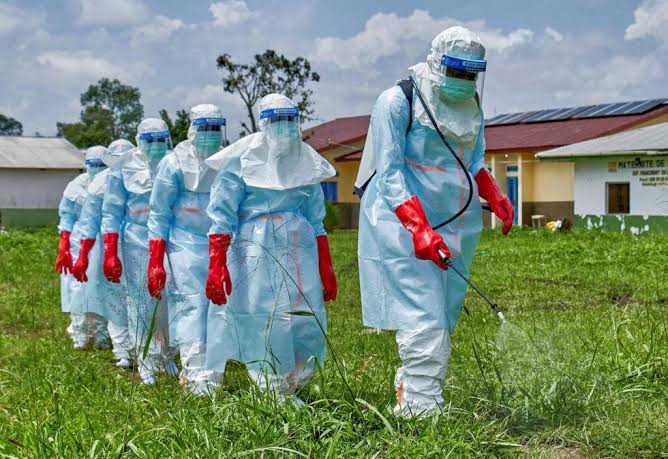
The NCDC has activated its incident management system to coordinate the response, while infection prevention and control measures have been intensified at the private facility where the woman sought treatment.
“The immediate priority is to establish whether transmission has occurred within Nigeria, identify exposed individuals and maintain effective surveillance at health facilities and points of entry,” health officials said. A single confirmed case does not, by itself, indicate widespread community transmission.
Regional and Global Context
The Bundibugyo strain confirmed in Nigeria is the same one driving the catastrophic outbreak in the DRC, which has recorded more than 9,000 cases and over 4,000 deaths since mid-May. Unlike the more common Zaire strain, there is currently no approved vaccine or specific treatment for the Bundibugyo species.
The outbreak has already demonstrated its ability to cross borders. Kenya has confirmed nine cases this month, all linked to an infected traveler who arrived from the DRC via Uganda. Uganda reported 20 cases in May and June, mostly imported from the DRC, but was declared free of Ebola by the WHO in August.
Health officials are still investigating exactly where the Nigerian patient was exposed. The Swiss government has said she did not travel to the DRC, contradicting earlier statements from Ugandan officials. The Africa Centres for Disease Control and Prevention (Africa CDC) is also examining whether she may have crossed paths with the Kenyan index patient at Uganda’s main airport on the same day, though no definitive link has been established. Genomic sequencing is underway to help trace the source of her infection.
Nigeria’s Preparedness
Nigeria’s last encounter with Ebola came in 2014, when an imported case arrived in Lagos from Liberia. Despite fears of rapid spread in Africa’s most populous city, Nigeria contained that outbreak within three months, recording 20 infections and eight deaths. That success is frequently cited as a model for rapid contact tracing and containment.
“We successfully contained Ebola in 2014 and have the systems in place to respond,” Health Minister Muhammad Ali Pate said.
The WHO is urging all countries in the region to sustain high levels of readiness, including strong surveillance, rapid response teams, and protection for frontline health workers. The agency continues to advise against travel and trade restrictions with affected countries.
Ebola spreads through direct contact with the blood or bodily fluids of an infected person, or with contaminated surfaces. It does not spread through the air. Early detection, isolation, and contact tracing remain the most effective tools for preventing wider transmission.
