

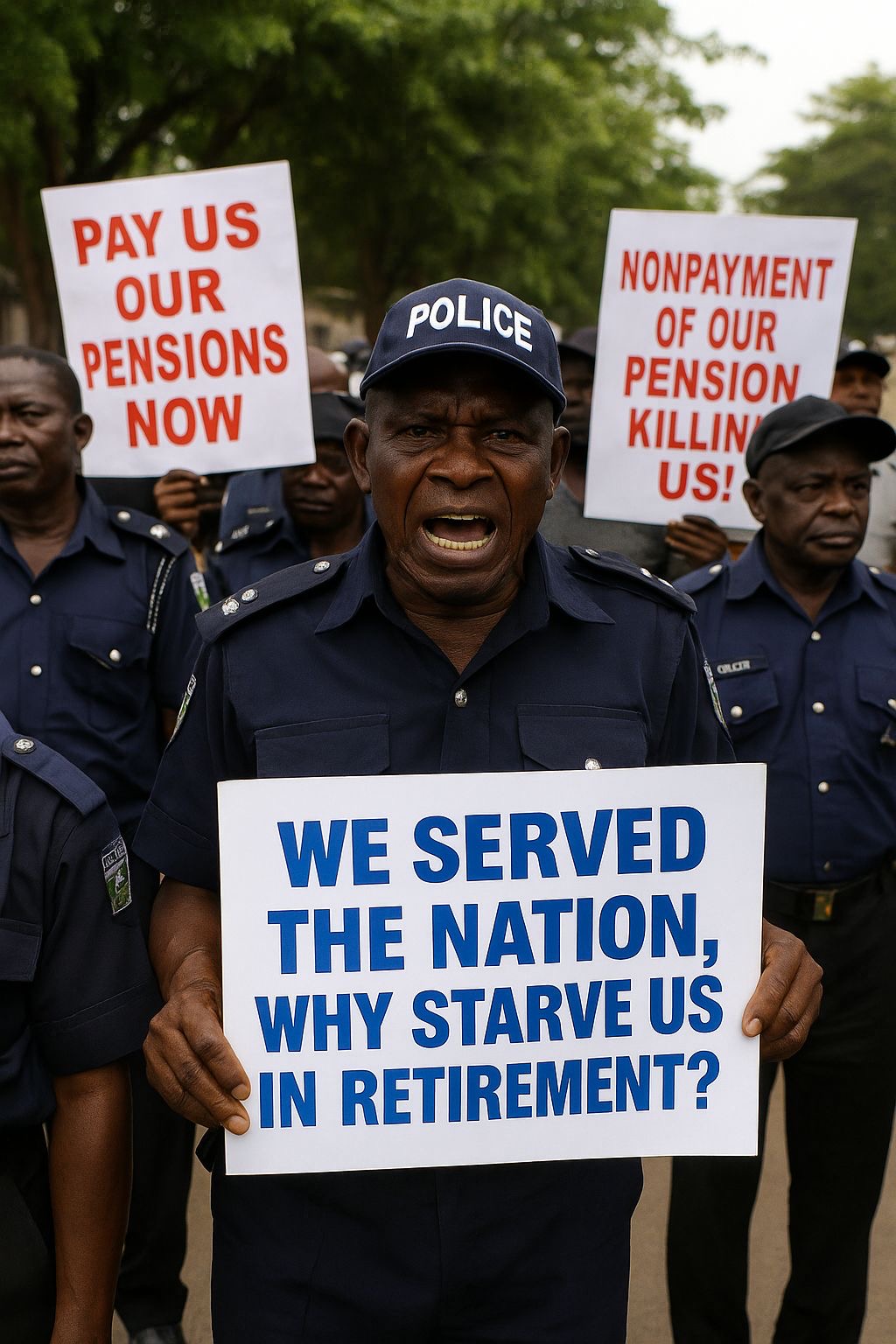
In what has become a familiar scene of governmental neglect and systemic failure, retired officers of the Nigerian Police Force have once again taken to the streets in protest over the non-payment of their pensions and accumulated allowances. These protests, which have become increasingly frequent and widespread, highlight a deeper, festering wound within Nigeria’s public service structure: the abandonment of those who once stood at the frontlines to maintain law and order, only to find themselves discarded in their most vulnerable years.
For decades, police officers in Nigeria have worked under some of the most difficult conditions imaginable—underfunded, under-equipped, under-appreciated, and grossly underpaid. They have braved the most volatile parts of the country during moments of unrest, civil disobedience, insurgency, and political instability. Yet, many of them now find themselves left without the basic benefits of retirement: timely pensions, gratuities, and medical care. Their protests are not mere acts of disobedience or civil defiance; they are desperate cries for dignity, justice, and survival.
The recent wave of protests began with scores of retired officers marching through city centers in Abuja, Lagos, Port Harcourt, and Kaduna, bearing placards with bold inscriptions such as “We served the nation, why starve us in retirement?” and “Pension delay is death sentence.” Their demands are simple and constitutionally justified: immediate payment of their outstanding pensions, release of unpaid gratuities, full enrollment into the contributory pension scheme with retrospective effect for those affected, and comprehensive medical support for aged and ailing retirees.
Many of these retired officers have not received any payment since leaving service, some for as long as five to ten years. Some who managed to receive part payments claim they were grossly underpaid due to fraudulent calculations or improper enrollment into the national pension systems. Several are reported to have died while waiting for their entitlements. Others are languishing in penury, with no means of sustaining themselves or their families. Their situation presents a grave humanitarian concern that challenges the moral and legal foundations of the Nigerian state.
The Nigerian Police Pension Scheme, historically marred by corruption, inefficiency, and administrative bottlenecks, lies at the heart of this crisis. Despite the 2004 Pension Reform Act and its amendments, which sought to establish a more robust and transparent contributory pension scheme, implementation within the police ranks has been inconsistent and poorly monitored. Many retirees complain of being moved arbitrarily between the old defined benefits scheme and the new contributory scheme, resulting in data loss, duplication, or outright disenfranchisement.
Former Inspector Generals and top-ranking officers, now vocal advocates of pension reform, have come forward to express solidarity with the protesting retirees. They warn that if left unaddressed, the crisis could breed widespread disillusionment within the force and contribute to an already fragile morale among serving officers. How can young officers commit themselves fully to national service when the future promises them only hunger, humiliation, and neglect?
The welfare implications are staggering. Several retirees who once served in elite tactical units, special anti-robbery squads, or volatile regions of the northeast now sleep under bridges, rely on alms from churches and mosques, and queue for free meals. Many battle age-related illnesses—diabetes, hypertension, arthritis—with no medical coverage or financial means to seek treatment. Others are dependent on overburdened family members. Their mental health, often unspoken, is also in crisis, with cases of depression, post-traumatic stress, and suicidal tendencies growing unchecked.
The culpability lies squarely on the shoulders of multiple actors. The National Pension Commission (PenCom), the Police Pension Board, and the Federal Government, particularly the Ministries of Finance and Interior, must bear collective responsibility. The systemic failures are not accidents of bureaucracy but symptoms of a deeper rot in governance—mismanagement of funds, lack of accountability, data misalignment, and corruption at institutional levels.
Even more alarming is the recurring accusation that funds meant for police pensions have been embezzled or diverted over the years. The 2013 pension scandal involving top civil servants who siphoned billions of naira meant for retirees is still fresh in public memory. Despite high-profile trials and convictions, little has changed. Audit trails remain weak, and transparency in pension fund disbursement is nearly nonexistent.
Immediate solutions must be swift, transparent, and people-centered. First, the Federal Government must declare a state of emergency on police pension administration and initiate a forensic audit of all outstanding pension and gratuity claims. Second, the full digitization and harmonization of all police retirement records must be completed without delay. This will ensure every retiree is captured accurately and paid accordingly. Third, an emergency bailout fund should be created to clear all arrears within a specified timeframe—no longer than six months. Delays are not just bureaucratic lapses; they are death sentences to thousands.
Furthermore, the National Assembly should conduct a public hearing to probe the consistent failure of pension delivery to police retirees, inviting stakeholders from civil society, pension fund administrators, and police unions. There should be legal reforms that compel automatic penalties for agencies that delay pensions beyond sixty days post-retirement. The Nigerian state must be held accountable to its own laws and moral obligations.
Public trust in the Nigerian Police Force has waned over the years due to issues of brutality, corruption, and impunity. However, this protest by retirees presents an opportunity to humanize the force and reframe public perception. These are not the images of rogue officers with whips and batons, but elderly men and women who gave the prime of their lives to national service, only to be discarded like worn-out uniforms.
If Nigeria hopes to restore dignity in its public service, it must start by treating its retirees with the honor they deserve. The dignity of a nation is measured not by how it treats the rich or the powerful, but by how it honors its elderly, its veterans, and its forgotten heroes.
The Nigerian police retirees protesting today are not merely fighting for themselves. They are speaking for the soul of the Nigerian state and challenging a culture of institutional amnesia. Their tears are a national indictment. Their cause is just. And their demands—urgent, non-negotiable, and morally binding.
Let no retiree die waiting. Let no pension be stolen. Let justice roll down like waters, and let every man who wore the badge of honor in Nigeria’s service receive his due.
Published by
Jide Adesina
1stAfrika.com
For press inquiries, interviews or contributions to this series on public sector pension injustice, please contact editor@1stafrika.com.
