
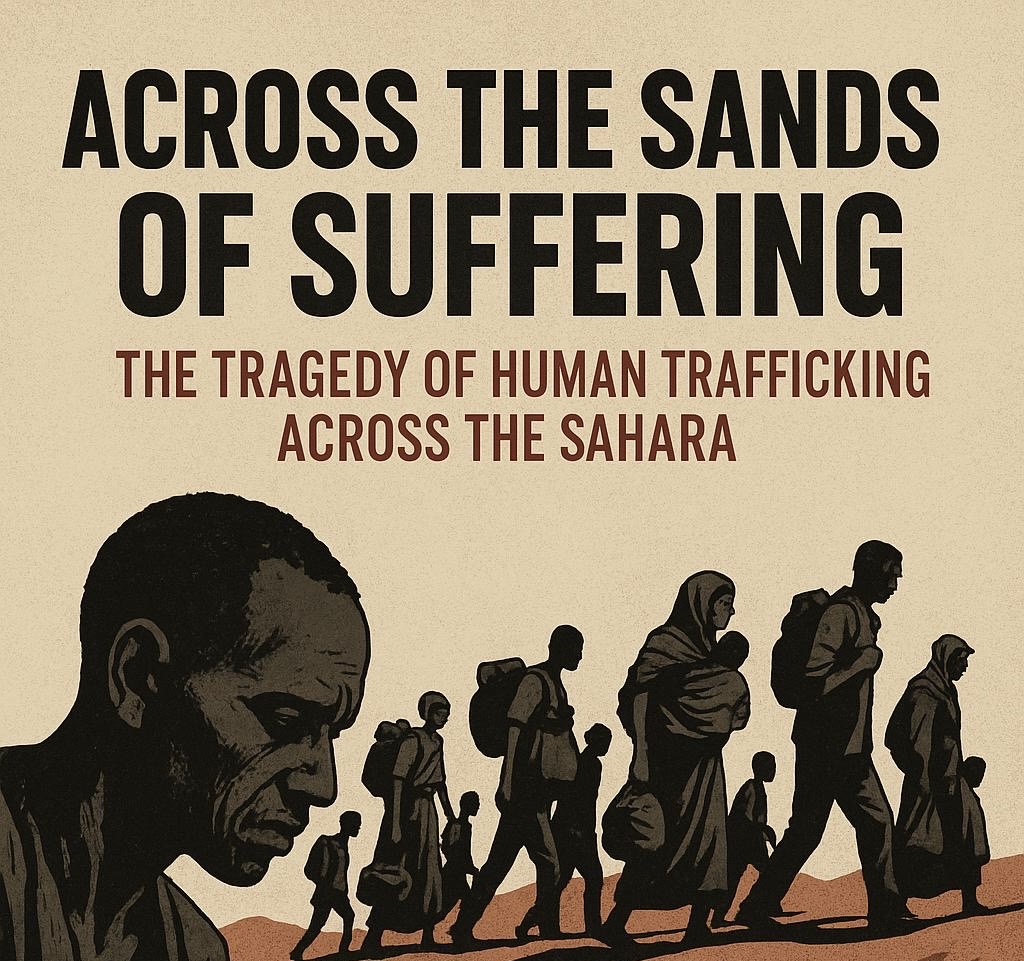
 In the brutal silence of the Sahara, where the sun strikes like a punishment and the wind carries whispers of prayers lost to the dunes, thousands of souls are smuggled, sold, and scattered. They are not merely numbers. They are the bodies and dreams of men, women, and children from across Sub-Saharan Africa—Nigerians, Malians, Sudanese, Eritreans, Chadians, Cameroonians—each of them bearing invisible shackles. They carry within them the ruins of war, the drought of economic despair, the hunger for safety, and the hope of a better tomorrow in Europe or America. But instead, they walk into a nightmare wrapped in the false promise of migration.
Human trafficking across the Sahara is not a new phenomenon, but its modern resurgence is a humanitarian catastrophe of epic proportions. It is a slow, silent genocide unfolding beyond the reach of most television cameras and beyond the conscience of global policy. According to the United Nations Office on Drugs and Crime (UNODC), thousands perish annually in the desert. These are not just “illegal migrants”; they are victims of modern-day slavery. Lured by smugglers masquerading as helpers, they are trafficked across borders in exchange for money, sex, labor, or even their very organs.
The journey often begins with dreams nurtured in the slums of Lagos, the refugee camps in Chad, or the broken towns of Eritrea. From Agadez in Niger—a notorious transit hub—to Sabha in Libya, human trafficking syndicates operate with terrifying efficiency. Armed militias, rogue military elements, corrupt officials, and global trafficking cartels work together in what has become one of the most profitable underground industries in the world. A 2020 UNODC report estimates that human traffickers operating between Central and West Africa to Libya earn over $150 million annually. These figures, however, mask the torment etched into each face caught in this shadow trade.
Agadez, once a majestic Saharan trade post, now reeks of desperation. Young girls are kept in crumbling safehouses, sexually abused by traffickers as “payment” for transit. Men are stripped, beaten, and held for ransom—forced to call family members in Ghana or Senegal to send money to secure their release. Those who resist or cannot pay are sold to militias or left to die in the desert. Some are executed and buried in shallow graves, their bones eventually swallowed by shifting dunes. Others are forced into back-breaking labor in mines or sold into servitude in lawless Libyan towns.
The trafficking routes extend like spiderwebs across Algeria, Libya, Sudan, and Egypt. Those who make it past the desert may be crammed into rickety boats in Tripoli, sailing across the Mediterranean, only to drown under European skies. The International Organization for Migration (IOM) estimates that over 25,000 people have drowned or gone missing in the Mediterranean since 2014. The Sahara, however, may be deadlier—an invisible graveyard without headstones or mourning.
Meanwhile, the policies designed to protect migrants often do the opposite. Closed-border strategies by the European Union, in collaboration with North African states, have created a funnel of containment in countries like Libya and Tunisia—states unfit to act as holding pens for human lives. These policies may reduce the number of migrants reaching Europe, but they increase the suffering endured en route. The EU’s controversial cooperation with the Libyan Coast Guard, funded with millions of euros, has led to the capture and forced return of thousands to detention centers where rape, torture, and extortion are rampant.
The United Nations has declared its commitment to ending human trafficking through its Global Plan of Action to Combat Trafficking in Persons and the Sustainable Development Goal 8.7, which calls for the immediate and effective measures to eradicate forced labor and end modern slavery. Yet, the implementation across African states is patchy at best. Border control is porous and inconsistently regulated. Corruption remains a significant barrier. Local police often collude with smugglers, while regional governments lack the political will or capacity to enforce anti-trafficking laws.
Still, hope glimmers in the work of a few determined actors. Grassroots organizations in Nigeria like Idia Renaissance and Pathfinders Justice Initiative provide rehabilitation and legal support to trafficking survivors. In Niger, UNICEF and IOM operate shelters in Agadez for intercepted migrants and rescued victims, offering medical care and psychological support. In Sudan and Libya, international agencies attempt rescue missions despite the threat of armed conflict and political chaos. These efforts, while noble, are fragments in a vast ocean of suffering.
To end this nightmare, the world must move from rhetoric to coordinated action. Border policies must be made humane, not just strategic. The root causes—poverty, war, political instability—must be addressed through long-term development plans and not short-term migration crackdowns. African governments must be held accountable and supported to dismantle trafficking networks, prosecute offenders, and protect victims. The international community must fund safe migration pathways and strengthen legal frameworks for labor mobility.
At the heart of it all, we must remember the human faces behind the crisis. A 16-year-old girl from Bauchi, raped repeatedly on the road to Sabha, only to be sold as a domestic slave in Tripoli. A young man from the Congo, locked in a desert cell in Tamanrasset, starving and forced to dig graves for fellow captives. A mother in Benin City who has not heard from her son in three years since he left for Algeria with dreams of Paris. These stories should shake the conscience of every policy-maker, every border guard, every voter.
Human trafficking is not a migration problem. It is a human rights catastrophe. It is a modern plague wearing the mask of economic opportunity. The sands of the Sahara hide too many unmarked graves. It is time the world stopped walking past them. It is time for a new justice that moves not only across borders but through the veins of a shared humanity. If not now, then when will the cries from the desert finally be heard?
#EndHumanTrafficking
#AcrossTheSahara
#MigrationWithDignity
By : Jide Adesina
1stafrika.com
All rights reserved
July,2025
