

In mid-August 2025, Mali’s ruling military junta announced the arrest of a French national, identified as Yann Christian Bernard Vezilier, alongside multiple military and civilian figures, including two Malian generals, on charges of orchestrating a destabilization effort in collaboration with foreign intelligence services. This development reflects the increasingly fraught dynamics between Mali’s regime and its former colonial power, France.
General Daoud Aly Mohammedine, Mali’s Security Minister, delivered the news in a televised statement, asserting that the arrests on August 1 had thwarted a planned subversive operation aimed at undermining the republic’s institutions. He alleged that Vezilier had acted “on behalf of the French intelligence service,” mobilizing political, civil society, and military actors to execute the scheme   .
National television broadcast images of 11 individuals purportedly implicated in the conspiracy. Among them were two high-ranking military officers: General Abass Dembélé, previously dismissed in May following his calls for an inquiry into alleged civilian deaths in Diafarabé, and General Néma Sagara, noted for her earlier role in combating insurgent groups  .
Reactions from France have been absent; no official comment had been provided at the time of reporting  .
Observers warn that this crackdown may serve broader political ends. Rida Lyammouri, an analyst at Morocco’s Policy Center for the New South, remarked that Mali’s rulers appear determined to suppress dissent before it gains momentum. He argued that similar detentions in recent months—targeting journalists, opposition figures, and civil society leaders—suggest the arrests may be more about intimidation than an actual coup attempt .
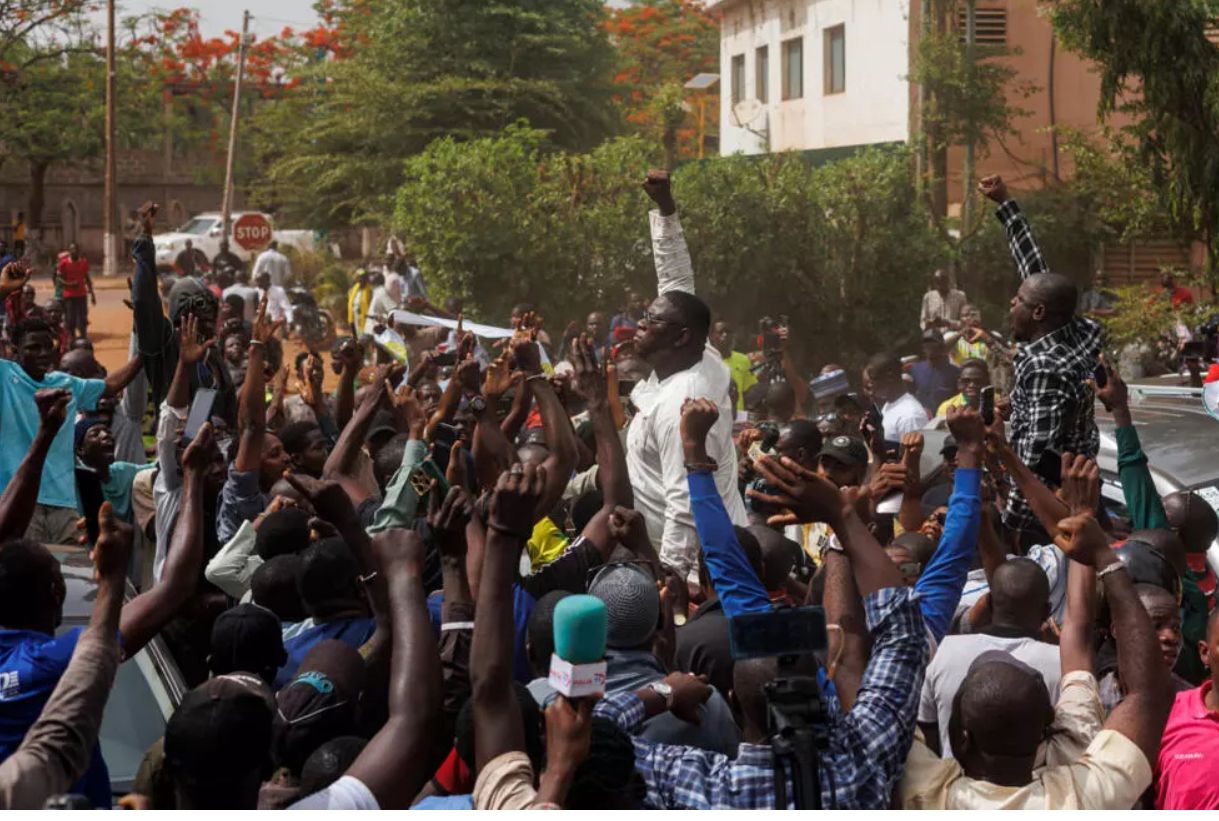
These arrests occur within a broader context of deepening instability and political retrenchment. Mali’s junta extended its hold on power by five years in June 2025, dissolving political parties and delaying promised transitions to civilian governance despite widespread pro-democracy protests in May—a rare expression of dissent since soldiers seized control nearly four years earlier   .
 Moreover, Mali’s security landscape remains volatile, with persistent threats from al-Qaida and Islamic State affiliates, as well as criminal militias. After expelling French troops, the junta has increasingly turned to Russian support for its security operations, signaling a strategic realignment away from Western partners   .
These developments reflect the broader erosion of trust between Mali’s rulers and France. Historical tensions have mounted in recent years, with Mali accusing France of violating its sovereignty, espionage, and even supplying arms to extremist groups—claims both denied and left unsupported with tangible evidence   .
In summary, Mali’s announcement of the arrest of a suspected French spy and Malian military officers underscores a deepening mistrust of France, a heightened clampdown on dissent, and the increasingly fraught geopolitics in the Sahel.
