

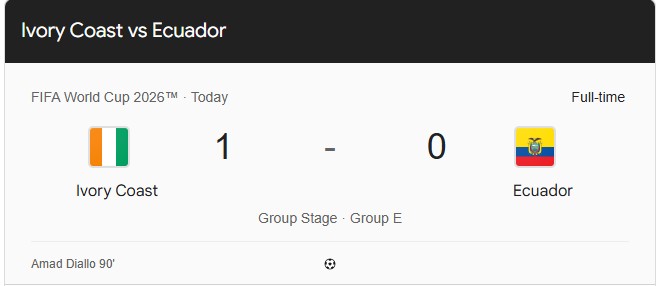
 As the clock drifted toward its final seconds and the tension inside Philadelphia Stadium became almost unbearable, Ivory Coast delivered the moment Africa had been waiting for. In a contest defined by discipline, resilience, tactical intelligence, and unwavering belief, the Elephants found a dramatic late breakthrough to edge Ecuador 1-0 in their opening FIFA World Cup 2026 Group E encounter.
This was not merely a football match. It was a declaration.
For more than ninety minutes, the African champions stood toe-to-toe with one of South America’s most organized and difficult teams. Ecuador arrived carrying a reputation built on defensive solidity and a squad featuring some of the most respected players in world football, including Moisés Caicedo and captain Enner Valencia. Their qualification campaign in South America demonstrated exactly how difficult they are to break down. Yet when the decisive moment arrived, it was Ivory Coast who showed greater patience, greater courage, and greater belief.
From the opening whistle, the match carried the intensity of a knockout contest. Every challenge was contested fiercely. Every possession mattered. Every mistake threatened to become decisive.
Ivory Coast entered the tournament carrying the momentum of their recent African success under coach Emerse Faé, whose remarkable leadership transformed the team into continental champions. This World Cup represents the country’s return to football’s biggest stage after missing recent editions, and the players performed like a side determined to make up for lost time.
The tactical discipline of the Ivorian side was evident throughout. Captain Franck Kessié marshaled the midfield with authority, while Seko Fofana covered enormous ground, constantly disrupting Ecuador’s rhythm. At the back, the defensive line remained compact and organized, refusing to allow Ecuador’s dangerous attackers any sustained freedom.
The contest unfolded like a chess match played at full speed.
Ecuador enjoyed periods of possession and attempted to exploit spaces through quick transitions, but Ivory Coast never lost its shape. Every time Ecuador appeared ready to build momentum, an orange shirt appeared to intercept, challenge, or force a mistake.
The young talents in the Ivorian side added excitement and unpredictability. Teenager Yan Diomande, entrusted with a starting role, displayed fearlessness against experienced opposition, while Nicolas Pépé brought composure and creativity whenever opportunities emerged. The blend of youth and experience gave the Elephants an edge that became increasingly visible as the match progressed.
As the second half advanced, the atmosphere changed.
The game began to resemble many classic World Cup battles where one moment would decide everything.
The Ecuadorian defense remained stubborn. Their back line, regarded as one of the strongest in South American football, absorbed wave after wave of pressure. Yet Ivory Coast never became desperate. Instead, they remained focused, trusting their structure, trusting their game plan, and trusting that an opportunity would eventually arrive.
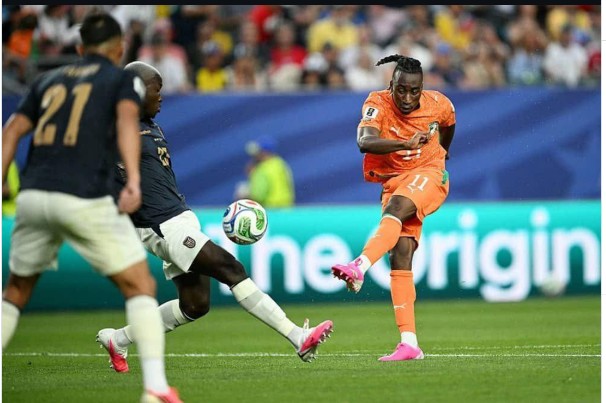
Then came the defining moment.
Deep into stoppage time, with spectators preparing themselves for what seemed destined to be a draw, Ivory Coast found the breakthrough. The move embodied everything that had characterized their performance: patience, intelligence, determination, and absolute belief.
The ball found its way into a dangerous area, defenders scrambled, and suddenly the net rippled.
The stadium erupted.
The Ivorian bench exploded with emotion.
Players sprinted toward the corner flag.
Supporters draped in orange celebrated a goal that may ultimately become one of the most significant African moments of the tournament.
Those final scenes captured the essence of World Cup football. Months of preparation. Years of dreams. Seconds of magic.
Beyond the result itself, the victory carries enormous significance for Africa.
For decades, African football has produced extraordinary talent but has often fallen just short of the ultimate breakthrough. The continent’s ambitions changed dramatically after Morocco’s historic run to the semifinals in Qatar 2022, proving that African nations are no longer outsiders but genuine contenders capable of competing with the world’s elite.
Ivory Coast’s performance against Ecuador reinforces that belief.
This was not a lucky victory. It was a mature World Cup performance against a highly respected opponent. It showcased organization, tactical sophistication, physical strength, and mental resilience. Most importantly, it demonstrated that African teams are increasingly capable of controlling matches rather than merely reacting to them.
The road ahead remains challenging. Germany’s emphatic victory over Curaçao has already established the Europeans as Group E favorites, setting up a fascinating showdown between Germany and Ivory Coast in the next round. Yet this opening victory places the Elephants in an excellent position within the group and strengthens hopes of a deep tournament run.
What makes this Ivorian team particularly dangerous is its balance. The defense is powerful. The midfield is experienced. The attack possesses pace and creativity. The squad contains players from some of Europe’s biggest leagues, yet they play with a collective spirit that often matters more than individual brilliance during World Cups.
Watching the match unfold felt like witnessing a team growing in confidence with every minute. The players understood the importance of the occasion. They understood what they represented. Every tackle, every interception, every sprint carried the weight of a continent hoping to see another African nation challenge football’s traditional powers.
Can an African team reach the final of the 2026 FIFA World Cup?
After performances like this, that question no longer sounds unrealistic.
Morocco opened the door in 2022. Ivory Coast appears determined to walk through it.
The tournament is still young, and many giants remain in contention. But on a dramatic night in Philadelphia, the Elephants reminded the football world that Africa’s ambitions are growing larger with every World Cup.
The final whistle may not have sounded yet, but one thing is already clear.
Ivory Coast has announced itself as a serious contender.
And Africa is watching.
