

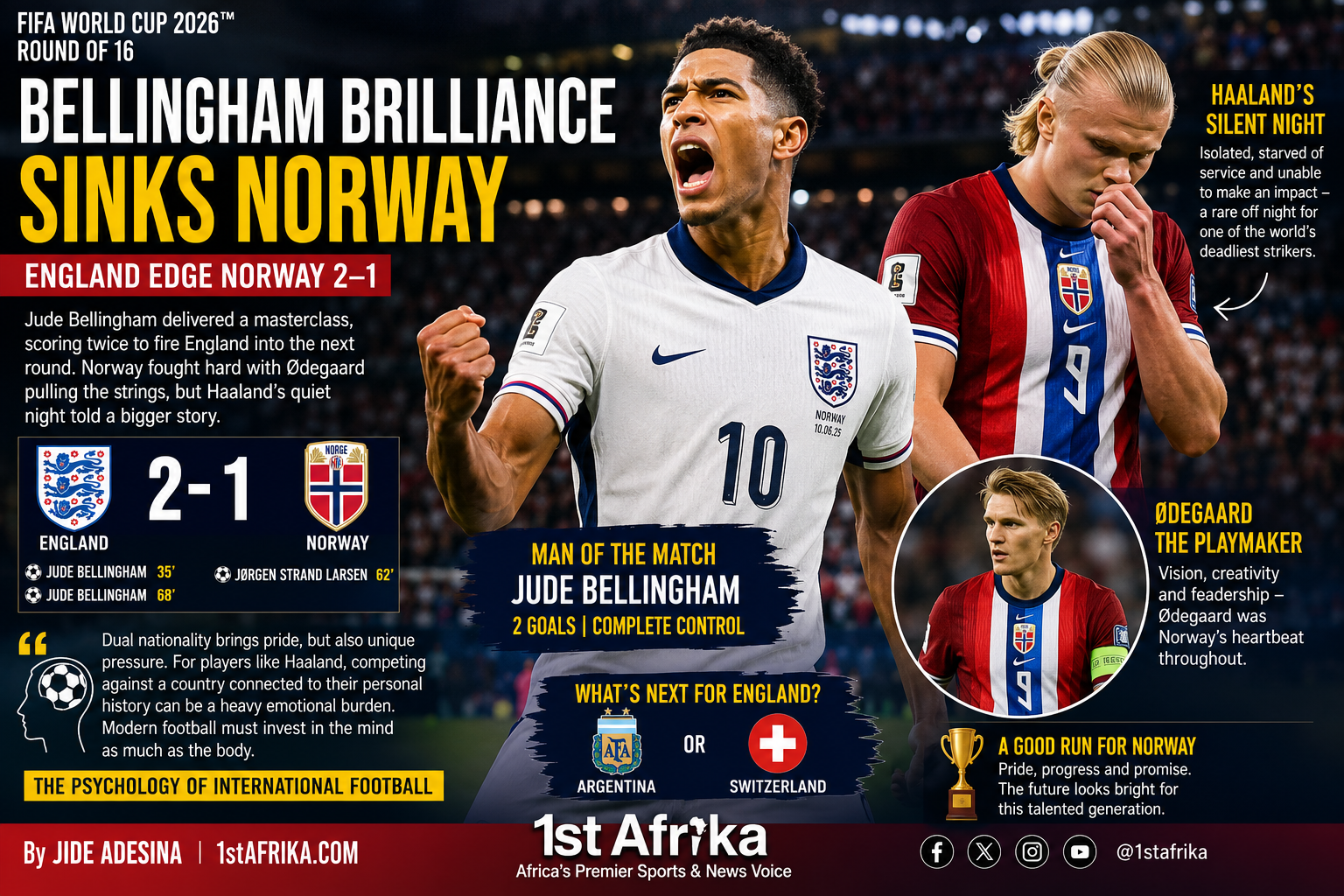
 England booked their place in the next round with a hard-fought 2–1 victory over Norway in a contest that showcased tactical discipline, individual brilliance, and the often-overlooked psychological dimension of international football.
The undisputed star of the evening was Jude Bellingham, whose two goals proved decisive and earned him a deserved Man of the Match award. Calm in possession, relentless in midfield, and clinical in front of goal, Bellingham once again demonstrated why he is regarded as one of the finest footballers of his generation.
Norway fought courageously until the final whistle. Martin Ødegaard orchestrated much of their attacking play with his trademark vision and passing range, but despite periods of impressive possession, Norway struggled to convert their creativity into enough clear-cut opportunities.
The biggest talking point, however, was the unusually subdued performance of Erling Haaland.
Widely regarded as one of the world’s most devastating strikers, Haaland was largely anonymous throughout the match. He appeared isolated for long stretches, received little quality service from teammates, and was unable to impose himself on England’s organized defensive structure. Whether it was England’s tactical discipline, Norway’s inability to supply him effectively, or simply one of those rare difficult evenings that every elite striker experiences, Haaland never looked like the dominant force football fans have come to expect.
His performance also invites discussion about a broader issue in modern international football: the psychological pressures faced by players with multicultural backgrounds or dual nationality options.
Although Haaland represents Norway with pride, he was born in England during his father’s professional career there. For many footballers with connections to more than one country, competing against a nation that also forms part of their personal history can create unique emotional pressures. Such circumstances do not determine performance, but they can add another psychological layer to an already demanding elite sporting environment.
A similar conversation has surrounded several dual-nationality players throughout football history. Representing one country while facing another with which you have deep personal, cultural, or family ties can present emotional challenges that statistics alone cannot measure.
Belgium’s recent goalkeeping situation has also illustrated how mental preparation can be just as important as physical fitness. Elite football is increasingly decided not only by tactics and technical ability but also by confidence, emotional resilience, and mental clarity under immense pressure.
As international football becomes more multicultural, national teams should continue investing in sports psychologists alongside technical coaches. Modern football demands more than physical conditioning and tactical preparation; it requires helping players manage identity, expectation, pressure, and emotional balance on the world’s biggest stages.
Norway should nevertheless leave the tournament with their heads held high. Their campaign demonstrated how far the nation has progressed, and with talents such as Haaland and Ødegaard still in their prime, the future remains exceptionally bright.
England, meanwhile, march on with renewed confidence. If results elsewhere fall into place, their next major challenge could come against either Argentina or Switzerland—a test that would require another outstanding collective performance.
For now, though, this night belonged to Jude Bellingham. Two goals, complete midfield control, and another reminder that England possess one of football’s most influential players. If he maintains this level, England’s World Cup dream will continue to gather momentum.
Final Score: England 2–1 Norway
Man of the Match: Jude Bellingham (2 goals)
Norway’s Standout Performer: Martin Ødegaard
