

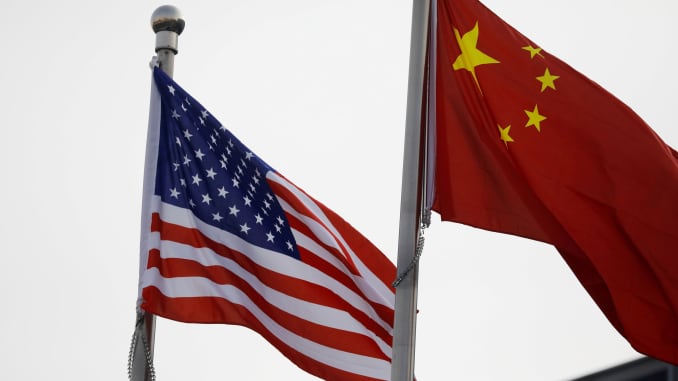
While investors have been preoccupied with rising prices, a flare-up in U.S.-China tensions could catch investors by surprise, BlackRock warns.
BlackRock Investment Institute said in a report Monday that its proprietary Geopolitical Risk Indicator has fallen to its lowest in four years, as investors focus more on inflation and the economic recovery than geopolitics
That marks a shift in attention from U.S.-China trade tensions or a North Korea nuclear attack, both of which have rattled markets in the last few years.
“The gauge has been hovering in negative territory this year … meaning investor attention to geopolitical risks is below the average of the past four years,” the report said. “As a result, geopolitical shocks could catch investors more off guard than usual.”
Geopolitical risk flareups could have an outsize impact when markets least expect it.BlackRock Investment Institute
One of the major risks markets might be overlooking is the separation, or “decoupling,” of the world’s two largest economies in technology. The analysts noted U.S. President Joe Biden has continued his predecessor’s tough stance on China “with a focus on critical technologies,” while Beijing is prioritizing self-reliance in tech.
“We see a high likelihood that decoupling of the U.S. and Chinese tech sectors accelerates in scale and scope, despite the relatively low attention to” the risks posed by Chinese and American technology splitting apart, the report said.
BlackRock’s geopolitical risk indicator is calculated using two metrics. One is a computer-based scoring system for positive and negative mentions of geopolitical risks in brokerage reports and financial news stories. The second metric is a model for potential one-month impact from geopolitical events on global assets.
The two measures are then combined to create an index. A positive reading, close to one, indicates the market performance matches the model’s prediction for reaction to geopolitical risks. A negative reading reflects markets are moving in a direction opposite to what the model predicts.
While BlackRock did not disclose the exact level of the index, the investment institute said Monday the indicator turned negative this year for the first time since 2017 — which means investors’ focus on geopolitical risks have fallen below the average of the last four years
world’s largest money manager, with about $8.7 trillion in assets under management. The Wall Street giant’s investment institute conducts proprietary research for clients and portfolio managers.
According to BlackRock, the indicator’s three most-likely geopolitical risks are:
- Separation of the U.S. and Chinese technology industries.
- A major cyberattack.
- Political crisis in emerging markets as a result of the countries’ inability to control the coronavirus pandemic.
Ranking fourth is rising U.S.-China tensions over Taiwan, a self-ruled island which Beijing considers part of its territory. The institute does not expect a “military showdown” over Taiwan this year, but said the tensions pose a “significant medium- and long-term risk.”
Market predictions
Growing tech rivalry between the U.S. and China means both governments will be investing more in the industry, making it “key to invest in both these poles of global growth,” the BlackRock analysts said.
In a separate report, they laid out their expectations for market reactions to other geopolitical risks.
For example, BlackRock Investment Institute expects the Chinese yuan to weaken if the separation of U.S. and Chinese tech companies accelerates. The analysts anticipate the U.S. dollar will strengthen and U.S. utilities stocks will decline if there’s a major cyberattack, and Latin American consumer staples stocks will rise if there is a political crisis in the emerging markets.
Global stock indexes have climbed this year as major economies strive to increase vaccination rates and resume business. The CBOE Volatility Index, or the VIX, a gauge of fear in the U.S. market, has fallen about 19% so far this year.
In the near term, BlackRock said it’s justifiable for markets to focus more on the economic recovery from the coronavirus pandemic and the outlook for inflation.
But they cautioned that “geopolitical risk flareups could have an outsize impact when markets least expect it.”
