

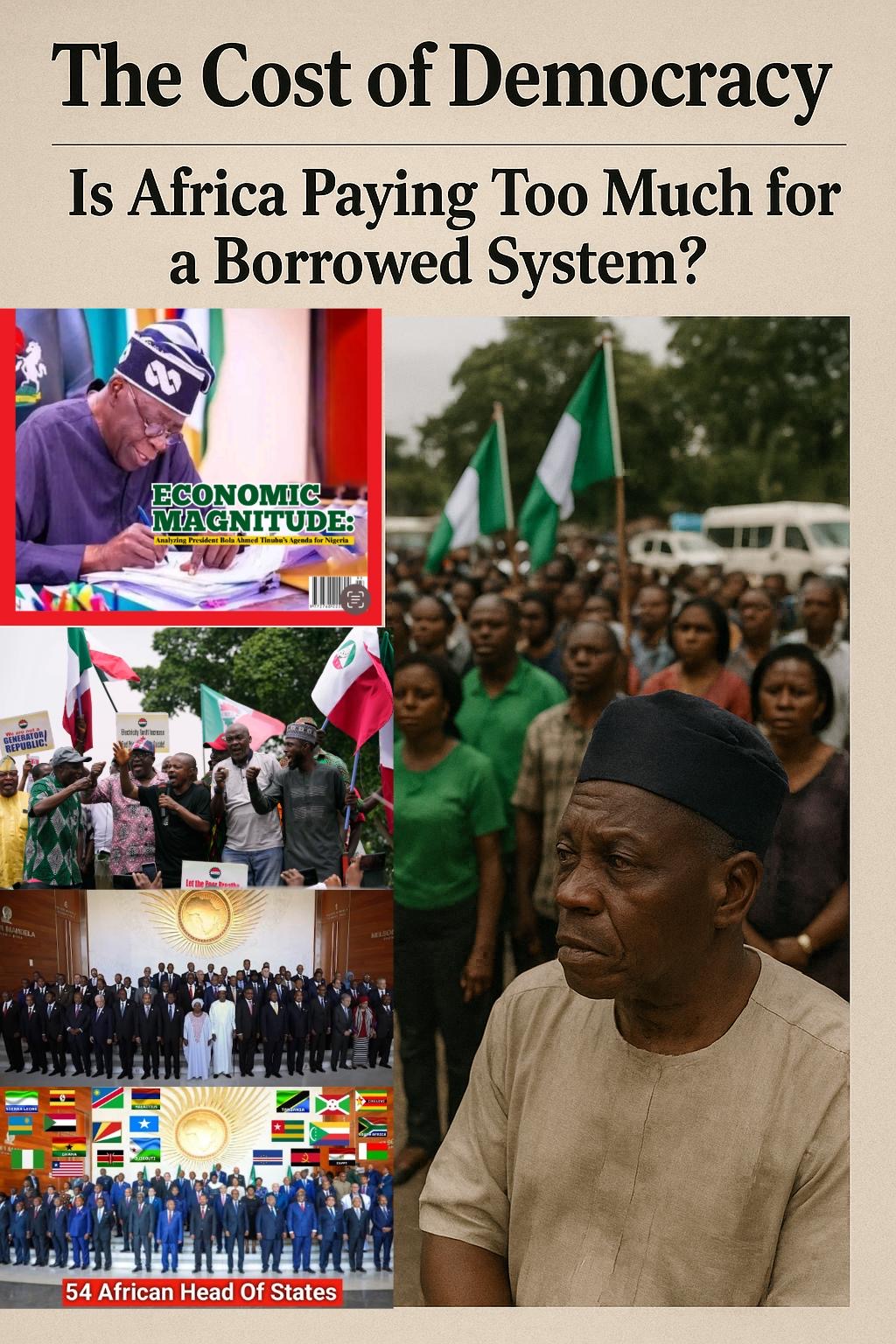
In the heart of Africa’s post-colonial journey lies a paradox — the promise of democracy and the price it extracts. The continent has, for decades, embraced democratic ideals handed down by colonial powers and Western allies, hailing multi-party elections, representative governance, and constitutionalism as pathways to progress. Yet today, across capitals from Abuja to Accra, Nairobi to Kinshasa, a growing number of citizens and scholars are asking a painful but necessary question: is democracy too expensive and dangerously unsustainable for Africa?
This question is not born out of cynicism but out of raw and disillusioned observation. Africa’s democratic experience, particularly in countries like Nigeria, reveals a staggering cost burden that drains already strained public coffers, fuels political instability, and sustains a class of elite rulers more invested in preserving privilege than in serving the people.
In Nigeria — Africa’s largest democracy by population and economic weight — the price of democracy has become a national burden. The 2023 general election alone was estimated by the Independent National Electoral Commission (INEC) to have cost over ₦355 billion (approximately $750 million), not including the vast sums expended by political parties, candidates, security forces, and the media ecosystem. Nigeria’s presidential candidates reportedly spent billions in naira on campaign advertising, political rallies, vote mobilization, logistics, and party primaries. Campaign financing is not only unchecked; it is obscenely extravagant, often bankrolled by shadowy donors, godfathers, and corruption-linked funds.
Beyond electioneering, the cost of maintaining the political structure is astronomically high. Nigeria operates a bloated federal system with 36 states, 774 local governments, and a National Assembly where 469 lawmakers earn some of the highest salaries and allowances globally. According to various credible sources, Nigerian senators earn over ₦13.5 million monthly in “running costs,” excluding base salary, which is officially ₦750,000 — a stark contrast to the nation’s minimum wage of ₦30,000. These “running costs” cover unverifiable expenditures like housing, newspapers, wardrobe, and constituency allowances, often disbursed without any measure of accountability or public service delivery. The Office of the President, Governors, and Ministers are also awash with huge security votes and discretionary spending powers that escape the scrutiny of anti-corruption agencies.
A democratic government that consumes over 70% of its national budget on recurrent expenditure — largely for political office holders and public bureaucracies — is not sustainable. The cost is not just monetary; it is social and moral. It fosters a culture of political entitlement and discourages merit-based governance. It breeds electoral violence, as political offices become lifelines for wealth and immunity, rather than platforms of public service. It distorts the priorities of governance, shifting attention from health, education, and infrastructure to political survival and patronage networks.
Should elected officials be paid for their services? In principle, yes — but what scale of remuneration is justifiable in countries where citizens live below the poverty line, public hospitals lack basic medications, and schools remain underfunded? The allowances for wardrobe, feeding, and furniture for Nigerian politicians evoke moral outrage in a country still grappling with 133 million multidimensionally poor citizens. Leadership in Africa must shift from consumption to sacrifice if democracy is to have moral legitimacy.
The problem is not democracy as an idea, but its adaptation as a system without context. African states did not emerge from a vacuum. Long before colonialism, complex systems of governance thrived across the continent. The Yoruba had the Oyo Mesi and Alaafin balancing power in a semi-republican structure; the Igbo practiced a form of acephalous democracy through councils of elders; the Ashanti Kingdom had a sophisticated system of checks and balances between chiefs and the Golden Stool; Ethiopia operated one of the world’s oldest monarchies with ecclesiastical influence. These systems, though imperfect, were organically rooted in the culture, language, and moral fabric of the people. They offered social accountability, community consensus, and leadership by merit and wisdom — not wealth or violence.
In recent years, there has been a resurgence of calls to integrate traditional systems of governance into modern political frameworks. South Africa has a House of Traditional Leaders; Ghana retains the chieftaincy institution with statutory recognition. Nigeria’s traditional rulers, though sidelined constitutionally, still wield immense cultural influence and can serve as custodians of conflict resolution, community mobilization, and moral leadership.
Could Africa chart a new model of governance — one that combines the representative elements of democracy with the values of communal governance and traditional leadership? A hybrid system, not unlike Botswana’s model where traditional leaders play advisory roles in legislative processes, might offer a more frugal, stable, and people-centered alternative. Instead of elections that cost billions and only enthrone elite capture, what if African nations invested more in consensus-building, community leadership councils, rotational leadership models, and technology-driven townhall systems?
Africa’s greatness cannot be imported. It must be built from within — using tools, systems, and philosophies that align with the continent’s historical experience, cultural diversity, and economic realities. A democracy that alienates the people, enriches the few, and devours the commonwealth is not a democracy worth defending.
It is time to reimagine governance in Africa — not through the lens of the West but through the wisdom of our ancestors, the failures of our present, and the promise of our future. Africa must dare to ask hard questions, even if the answers challenge decades of political orthodoxy. If democracy is to survive and serve Africa, it must be restructured, demystified, and decolonized. Otherwise, the continent will remain trapped in a vicious cycle of expensive elections, poor governance, and unfulfilled aspirations.
Democracy must serve Africa — not bankrupt it.
By: Jide Adesina
1stafrika.com
August 1st, 2025
