

In a move that underscores both its long-term commitment to American innovation and its delicate navigation of political and economic headwinds, Apple has announced an additional $100 billion investment in U.S. manufacturing and supply chains. This latest pledge, unveiled at a high-profile White House event with President Donald Trump, brings Apple’s total U.S. investment commitment to a staggering $600 billion over the next four years—a figure that dwarfs previous corporate spending initiatives in the country.
Yet beneath the headline-grabbing numbers lies a more nuanced reality. While Apple is undeniably deepening its roots in American industry, the investment is as much about appeasing political pressures and insulating itself from trade disruptions as it is about fundamentally reshaping where iPhones are made. The tech giant remains tethered to a sprawling global supply chain, and despite Trump’s repeated calls for full iPhone production on U.S. soil, experts agree that such a shift remains economically unfeasible—at least for now.
A Manufacturing Push with Political Undertones
The announcement, framed as the launch of Apple’s American Manufacturing Program (AMP), signals a concerted effort to bring more of the company’s critical component production stateside. Key partners in the initiative include Corning, which will expand its Kentucky facility to supply glass for every iPhone and Apple Watch sold globally; Texas Instruments, enhancing semiconductor production in Utah and Texas; and Samsung, which will deploy cutting-edge chipmaking technology at its Austin fab—a first for the U.S. market .
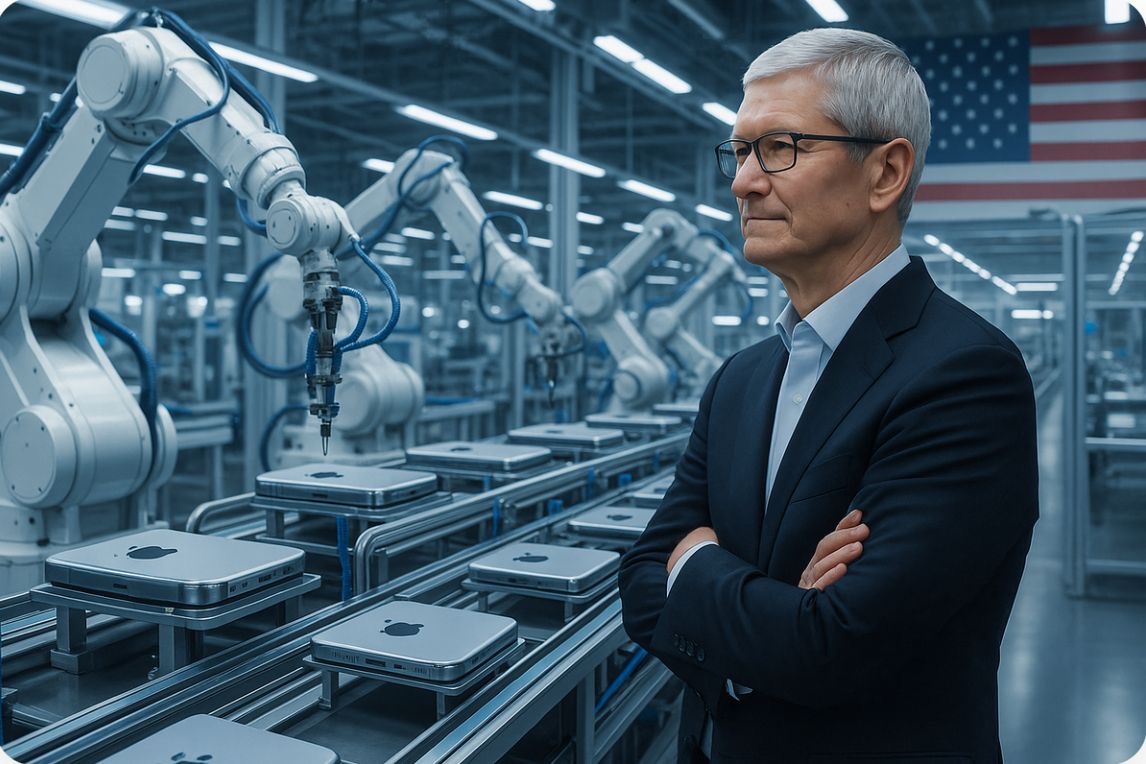 The political backdrop to this investment is impossible to ignore. Trump, who has long pressured Apple to repatriate iPhone assembly, framed the announcement as a victory for his “America First” agenda. “Companies like Apple, they’re coming home,” he declared in the Oval Office, where Apple CEO Tim Cook presented him with a commemorative glass piece from Corning’s Kentucky plant . Yet the reality is more measured. While Apple is indeed expanding U.S. production of semiconductors, display glass, and Face ID modules, Cook acknowledged that final iPhone assembly will remain overseas “for a while” due to the entrenched complexities of global manufacturing .
Tariffs, Trade Wars, and Tactical Maneuvering
Apple’s latest investment also serves as a strategic hedge against escalating trade tensions. The company has already absorbed $800 million in tariff-related costs this year, with another $1.1 billion hit expected in the coming quarter . Trump’s recent threats of 100% tariffs on foreign-made semiconductors-coupled with a 50% levy on Indian imports—have forced Apple to accelerate its pivot toward U.S.-sourced components. By committing to domestic production, Apple secures exemptions from these punitive measures, a critical concession given that iPhones sold in the U.S. are now primarily assembled in India to circumvent Chinese tariffs .
Analysts view the move as a savvy compromise. “This is a way for Apple to placate the White House without upending its supply chain,” said Daniel Ives of Wedbush Securities. The investment aligns with Apple’s existing spending trends but packages it as a bold, Trump-friendly initiative . Notably, the $600 billion figure includes previously announced projects, such as a **$500 million rare earths deal with MP Materials and a Houston-based server factory for Apple’s AI infrastructure .
The Limits of Reshoring
Despite the fanfare, Apple’s U.S. expansion has clear boundaries. The company’s 2019 showcase of a Texas Mac Pro factory—touted as a revival of American manufacturing—quietly shifted production to Thailand years later . Similarly, while Apple’s 19 billion U.S.-made chips and Kentucky-sourced glass mark progress, analysts estimate that relocating iPhone assembly would inflate costs by 20–40%, a nonstarter in a fiercely competitive smartphone market .
Instead, Apple is focusing on high-value sectors where the U.S. holds an edge: silicon engineering, AI, and advanced materials. Its Arizona-based partnership with TSMC, for instance, will produce next-gen chips for iPhones, while a new Detroit Manufacturing Academy aims to train small businesses in smart production techniques . These efforts, though less flashy than a “Made in USA” iPhone, could yield greater long-term dividends by strengthening America’s tech ecosystem.
Market Reaction and the Road Ahead
Investors initially cheered the news, sending Apple shares up 5%—their biggest jump in months . Yet the stock remains down double-digits year-to-date, reflecting broader concerns over Apple’s AI lag and reliance on a slowing iPhone market .
For now, Apple’s $600 billion pledge is a masterclass in corporate diplomacy: enough to satisfy political demands, mitigate tariff risks, and bolster its U.S. footprint—without upending a supply chain that has fueled its success for decades. Whether it’s enough to keep Trump’s tariffs at bay, or to truly reshape where Apple’s products are made, remains an open question. But one thing is clear: in the high-stakes game of global trade, Apple is playing both offense and defense.
