

A comprehensive review of Africa’s most populous nation’s economic trajectory, key performance indices, sectoral drivers, and the strategic reforms needed to unlock a $1 trillion economy.
By Jide Adesina | 1stafrika.com
Executive Summary
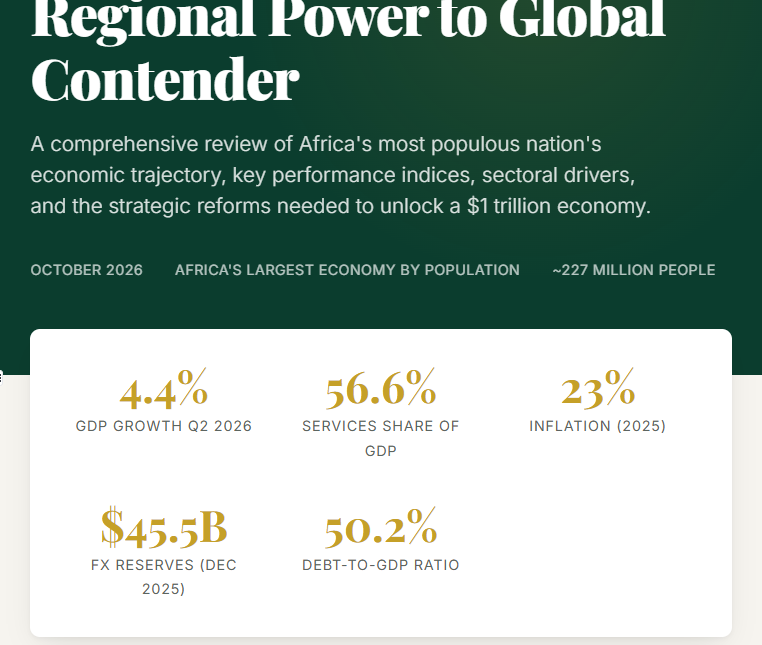
Nigeria stands at a critical inflection point. After years of sluggish growth, macroeconomic instability, and over-reliance on oil, the economy is showing signs of genuine renewal. Under the Tinubu administration’s bold reform agenda, GDP growth accelerated to 4.43% in Q2 2026, the fastest pace in five years. The services sector now dominates at over 56% of GDP, agriculture has rebounded sharply, and the non-oil economy contributes 95.8% of output, fundamentally reshaping Nigeria’s economic identity.
Yet significant challenges remain. Inflation, though easing from a peak of 33.2% to 23% in 2025, continues to erode living standards. Poverty has risen sharply, with an estimated 31% of the population in extreme poverty. Infrastructure deficits, insecurity, and a shallow financial system constrain the economy’s true potential. The path from stabilization to global competitiveness will require sustained, complementary reforms across fiscal policy, industrialization, security, and human capital.
Key Economic Indices
Nigeria’s macroeconomic indicators reveal an economy in transition: stabilizing after a period of crisis, but not yet delivering broad-based prosperity. The following table summarizes the most critical indices from 2024 to 2026:
| Indicator | 2024 | 2025 | Q2 2026 | Trend |
|---|---|---|---|---|
| Real GDP Growth | 3.1% (est.) | 4.0% | 4.43% | Accelerating |
| Nominal GDP (USD) | $372.8 billion | $291 billion | Expanding | Volatile (FX-driven) |
| Inflation (Annual) | ~29% | 23.0% | Easing | Declining |
| Tax Revenue / GDP | ~10.8% | 13.5% | Rising | Improving |
| Public Debt / GDP | 52.3% | 50.2% | Stable | Contained |
| Fiscal Deficit / GDP | 1.5% | 2.4% | Widening | Concerning |
| Current Account / GDP | Positive | +6.0% | Strong | Healthy |
| FX Reserves | $40.6 billion | $45.5 billion | Growing | Strengthening |
| Exchange Rate (NGN/USD) | ~1,500 | ~1,300 | Appreciating | Stabilizing |
| Extreme Poverty Rate | Rising | ~31% | Persistent | Critical |
The divergence between nominal GDP in naira terms and dollar terms is striking. While the naira value of output has grown substantially, currency depreciation has shrunk Nigeria’s dollar-denominated economy from $668 billion in 2019 to roughly $291 billion in 2025. This underscores a central truth: macroeconomic stabilization and exchange rate credibility are prerequisites for global economic status.
Sectoral Drivers
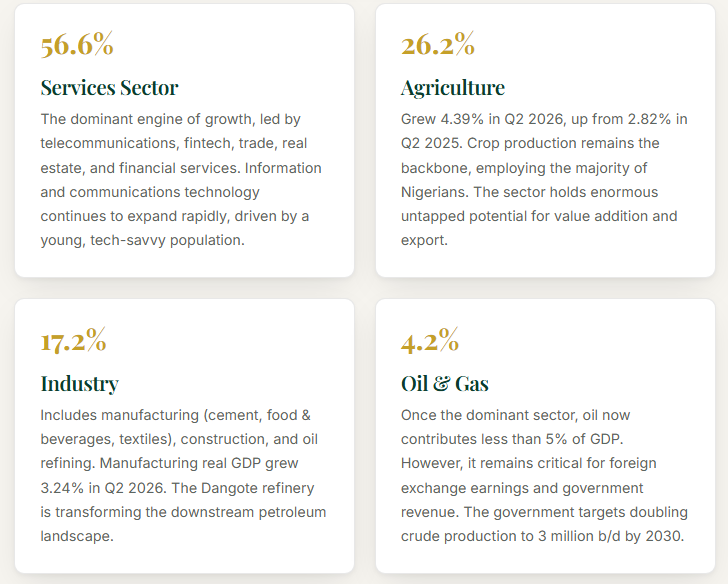
The most profound shift in Nigeria’s economy is the declining dominance of oil. In Q2 2026, oil accounted for just 4.16% of GDP, while the non-oil sector contributed 95.84%. The economy is now fundamentally services-led, agriculture-supported, and manufacturing-aspirational.
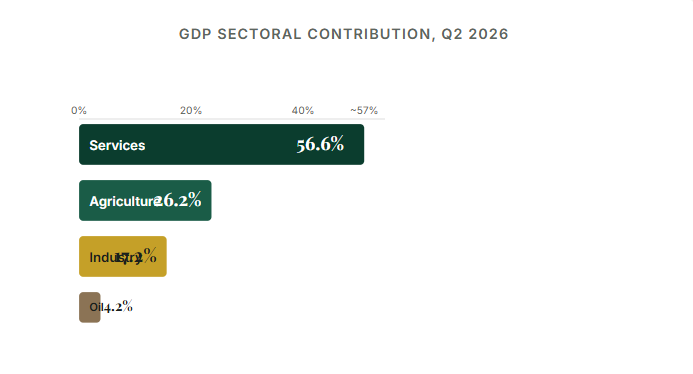
Services Sector — 56.6%
The dominant engine of growth, led by telecommunications, fintech, trade, real estate, and financial services. Information and communications technology continues to expand rapidly, driven by a young, tech-savvy population.
Agriculture — 26.2%
Grew 4.39% in Q2 2026, up from 2.82% in Q2 2025. Crop production remains the backbone, employing the majority of Nigerians. The sector holds enormous untapped potential for value addition and export.
Industry — 17.2%
Includes manufacturing (cement, food & beverages, textiles), construction, and oil refining. Manufacturing real GDP grew 3.24% in Q2 2026. The Dangote refinery is transforming the downstream petroleum landscape.
Oil & Gas — 4.2%
Once the dominant sector, oil now contributes less than 5% of GDP. However, it remains critical for foreign exchange earnings and government revenue. The government targets doubling crude production to 3 million b/d by 2030.
The Reform Agenda: What Is Driving the Turnaround?
Since mid-2023, the Tinubu administration has pursued a bold and painful reform agenda that has fundamentally altered Nigeria’s economic trajectory. Three landmark policy shifts stand out:
1. Fuel Subsidy Removal
The removal of the petrol subsidy, long a fiscal black hole consuming trillions of naira annually, freed up critical resources for public investment. While it triggered a sharp rise in transport and living costs, it also eliminated a regressive transfer that primarily benefited smugglers and the wealthy. The government claims debt service-to-revenue has dropped from 97% to under 50% since the reforms began.
2. Foreign Exchange Unification
The Central Bank of Nigeria unified the multiple exchange rate windows that had distorted trade, encouraged arbitrage, and deterred foreign investment. The naira initially plunged but has since stabilized and appreciated to roughly 1,300 per dollar by late 2025. Foreign portfolio investors have begun returning, with Nigerian stocks re-entering global frontier market indices.
3. Tax & Revenue Reforms
The Tax Reform Act and digitization of revenue collection have lifted the tax-to-GDP ratio from barely 7% a few years ago to 13.5% in 2025. While still far below the African average of 16%, this represents a meaningful improvement in fiscal capacity and reduces dependence on oil receipts.
“There is no single decision we have taken that is not guided by the pursuit of balance between economic logic and public expectation. Every reform we have introduced has emerged from deep reflection, difficult conversations, and the courage to act in the national interest.”
— President Bola Tinubu, October 2025
Challenges on the Path to Prosperity
Despite encouraging growth figures, Nigeria faces deep structural challenges that threaten to derail its global ambitions if left unaddressed:
Insecurity & Business Climate
Widespread banditry, kidnapping, terrorism, and communal violence have increased the cost of doing business, disrupted agricultural supply chains, and deterred both domestic and foreign investment. The US withdrawal of military assistance in 2026 underscores the severity of the security crisis.
Infrastructure Deficit
Over 86 million Nigerians lack access to electricity. Unreliable power supply forces firms to rely on expensive diesel generators, eroding competitiveness. Poor roads, ports, and rail networks inflate logistics costs and limit market access.
Poverty & Inequality
The cost-of-living crisis triggered by reforms has pushed more Nigerians into poverty. The World Bank estimates the poverty headcount ratio rose to 61% in 2025, up from 40% in 2019. Growth is not yet translating into jobs or income gains for most citizens.
Shallow Financial Markets
Stock market capitalization averages just 11.8% of GDP, one of the lowest in Africa. Limited access to credit, especially for SMEs, constrains enterprise growth and innovation.
How Nigeria Can Become a Global Economy
Transforming Nigeria into a globally competitive, $1 trillion economy by 2030, as envisioned by policymakers and analysts, requires moving beyond stabilization into a phase of consolidation and acceleration. The following strategic priorities are essential:
01. Accelerate Industrialization & Manufacturing
The Nigeria Industrial Policy (2025-2035) aims to grow manufacturing to at least 25% of GDP by 2035. To get there, Nigeria must fix the gas-to-power value chain, offer targeted incentives for agro-processing and solid minerals, and replicate the Dangote refinery model across other sectors. Special economic zones and export-oriented industrial parks should be prioritized.
02. Resolve the Energy Crisis
Electricity is the single biggest constraint on productivity. Nigeria must fully liberalize the power sector, attract private investment into generation and distribution, and complete critical gas infrastructure. A reliable power supply would instantly improve manufacturing competitiveness and reduce business costs.
03. Secure the Country & Protect Investments
No economy can thrive amid pervasive insecurity. Constitutional reforms enabling state-level policing, increased investment in intelligence and surveillance, and economic interventions in conflict-prone regions are necessary. Security is not just a social issue; it is an economic imperative.
04. Deepen Domestic Revenue & Fiscal Discipline
Raising the tax-to-GDP ratio to 18-20% within five years is achievable through further digitization, broadening the tax base, and curbing leakages. Nigeria must also enforce its fiscal responsibility law, keeping deficits below 3% of GDP and improving transparency in spending.
05. Invest in Human Capital & Education
With a median age of 18, Nigeria’s youth bulge is either a demographic dividend or a ticking time bomb. Quality education, vocational training, and digital skills programs are essential to equip the workforce for a global economy. Health investments to reduce maternal mortality and improve life expectancy are equally critical.
06. Expand Non-Oil Exports & Regional Trade
Nigeria must move from being a commodity exporter to a value-added goods and services exporter. The African Continental Free Trade Area (AfCFTA) offers a vast market. Nigeria should position itself as a manufacturing and services hub for West Africa, leveraging its scale and entrepreneurial energy.
07. Strengthen Institutions & Fight Corruption
Global credibility requires institutional integrity. Nigeria must improve contract enforcement, streamline business regulations, protect property rights, and ensure judicial independence. A credible anti-corruption framework will boost investor confidence and lower the country’s risk premium.
08. Build a $100 Billion Foreign Reserve Buffer
Doubling reserves from roughly $54 billion to $100 billion by 2028 would provide exchange rate stability, reduce import vulnerability, and signal global confidence. This requires consistent reserve accretion rather than artificial currency interventions.
The Road Ahead
The African Development Bank projects Nigeria’s real GDP growth at 4.1% in 2026 and 3.7% in 2027, supported by services, oil and gas, and public investment. Inflation is expected to remain in double digits but continue its downward trajectory. The current account is forecast to stay in surplus, underpinned by oil exports and remittances.
However, the real test is whether growth can accelerate to 7% annually, the minimum rate needed to significantly reduce poverty and absorb the millions of young Nigerians entering the workforce each year. Analysts at the NTU-SBF Centre for African Studies argue that achieving this requires Nigeria to complete the second phase of its economic roadmap: moving from stabilization to broad-based, job-creating growth.
Nigeria possesses all the raw ingredients of a global economic power: abundant natural resources, the largest consumer market in Africa, a dynamic and entrepreneurial population, and a strategic geographic position. The reforms of 2023-2026 have proven that change is possible. The next chapter will determine whether that change becomes transformation.
“If we stop here, we risk losing the progress that has been so courageously won. The challenge before us is to move decisively into the consolidation phase, embedding reforms in ways that drive jobs, growth, and inclusion.”
— Olaniyi Yusuf, Chairman, Nigerian Economic Summit Group
